
How Many Google Reviews Do Real Estate Agents Need?
Use consumer benchmarks for review count, ratings, and recency to build a practical 12-month plan based on your transaction volume.
By Rajwinder Mahal
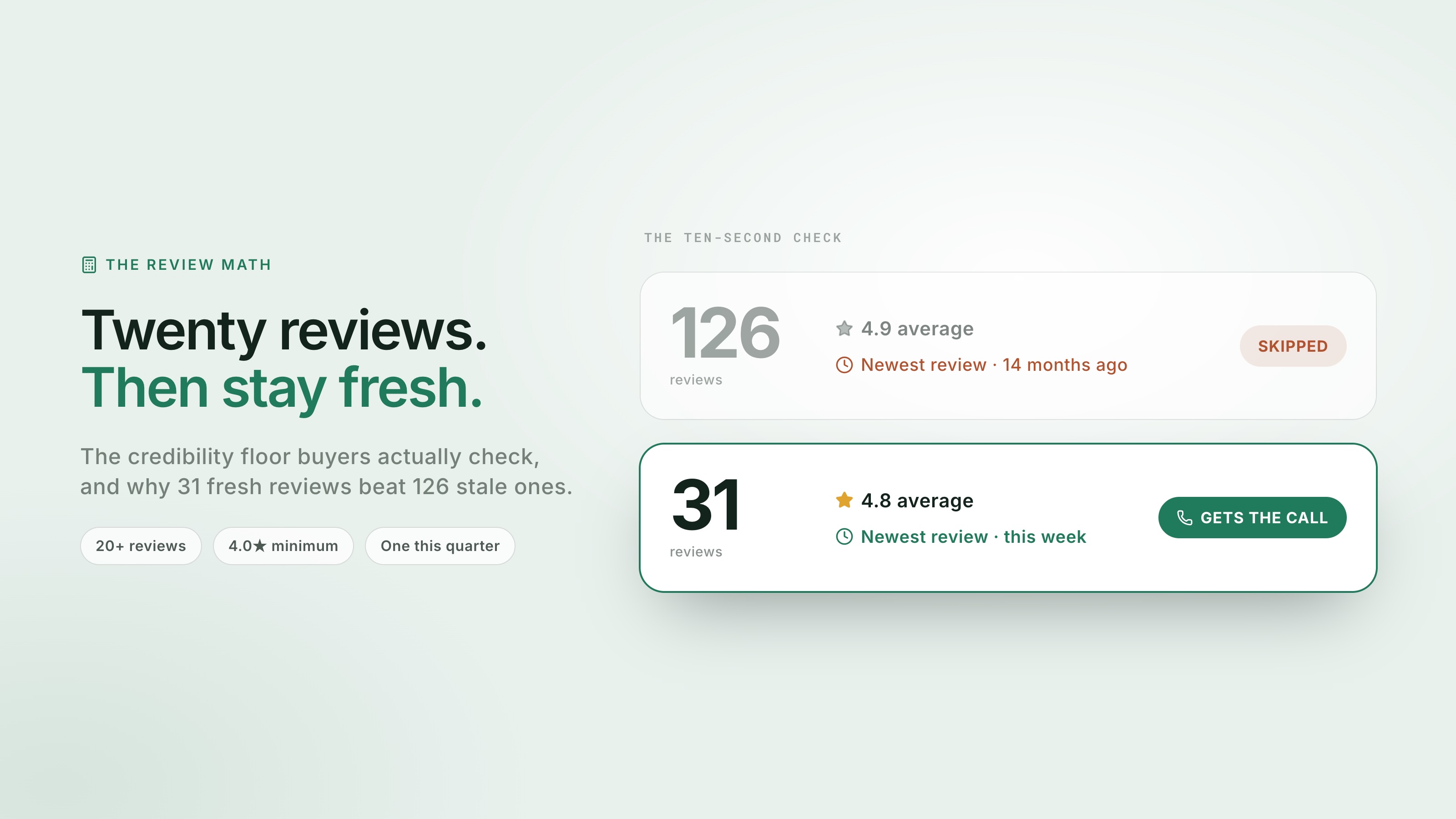
A useful starting benchmark is 20 reviews, at least a 4.0 average, and activity within the last three months. In BrightLocal's Local Consumer Review Survey 2026, 47% of consumers said they would not use a business with fewer than 20 reviews, 68% required a minimum 4.0 rating, and 74% looked for reviews from the previous three months. The survey covers local businesses broadly, not real estate alone, so these are planning benchmarks rather than universal cutoffs. Your next target should reflect the agents prospects see in your market. Here is how to find that number and build a realistic plan to reach it.
What do consumers actually check before contacting an agent?
Prospects can assess three things at a glance: your star rating, review count, and the date of your newest review. The 2026 BrightLocal data puts numbers on each. For rating, 68% of consumers require at least 4.0 stars, and 31% require 4.5 or higher, nearly double the previous year's 17%. For count, 47% avoid businesses with fewer than 20 reviews, while only 9% accept five or fewer. For recency, 74% look for reviews from the last three months, 32% want one from the last two weeks, and 18% focus on the past week.
The research does not establish 200 reviews, or any other large total, as a magic number. The practical goal is to answer three common questions: Have enough people worked with this agent? Were their experiences consistently positive? Is the feedback recent? Clear those concerns first, then compare your profile with the agents prospects see nearby.
Why does your market set the real target?
Because prospects compare the profiles in front of them. Someone who searches "real estate agent in [your town]" may see several local profiles together, while a referred prospect may compare your name with one or two others. A total that looks established in one market can look thin in another.
To find the local benchmark, search the phrases clients are likely to use, note the review counts and ratings of the agents who appear, and calculate the median. Repeat the check from a few locations in your service area because local results vary by searcher and location. Treat the result as a snapshot, not a complete ranking audit. Review count is only one part of local ranking; Google also considers relevance, distance, and prominence. You do not need to out-count every agent, but your profile should look credible and current beside the visible alternatives.
AI assistants add another place where public reputation may matter. BrightLocal reports that 45% of consumers use generative AI tools for local business recommendations. These tools use different sources and methods, and no public universal threshold determines which agents appear. A consistent set of recent, specific reviews can provide useful third-party evidence, but it cannot guarantee a mention or recommendation. That distinction is covered in our guide to getting found by AI.
How should you balance recency and volume?
The research shows that recency matters, but it does not prove that recency is always worth more than volume. Once your total no longer looks like an obvious weakness, prioritize a steady collection habit. To a prospect, a profile with 30 reviews and several from the current quarter may look more active than one with 120 reviews and nothing from the past year.
That changes how you should collect reviews. Ten reviews spread across a year keep the profile current for longer than ten collected in one week. Build the request into your normal closing process instead of running an occasional campaign.
What's the 12-month plan to get there?
Start with your own pipeline and your own data. Annual closings multiplied by an estimated request-to-review rate gives you a planning target. For illustration, a 50–70% planning range would give an agent who closes 20 transactions and asks every client about 10–14 reviews a year. This is not an industry benchmark or a guaranteed response rate. Replace it with your own data as soon as you can. Then use this plan:
- Month 1: ask past clients you missed. Make a list of recent clients you never asked and send each person a private note with your direct review link. Offer no incentive; Google prohibits giving anything of value for a review.
- Months 2–12: add the request to every closing. Send a personal request after the client has experienced your full service, then one polite follow-up a week later. Your response rate will vary, but no one can review you if you never ask. Our review request scripts cover several channels.
- All year: respect the client's wording and respond to every review. Do not ask clients to include specific content. When a reviewer chooses to share details, those details can give prospects useful context. Respond to positive and negative feedback; 89% of consumers expect businesses to reply. See how to handle a bad review for the difficult cases.
Track requests sent, reviews received, your conversion rate, and your current count compared with the local median. If follow-through is lower than expected, check the friction in your request, the timing, and whether your follow-up is consistent.
What if you're brand new and starting from zero?
An empty profile gives prospects little evidence to evaluate, so focus first on genuine reviews from real clients. The experience does not have to be a traditional home purchase: rentals and services provided during a deal that did not close can still be reviewed when the feedback reflects a real experience. Do not manufacture volume through family members, current or former coworkers, industry competitors, or anyone else with a conflict of interest; those reviews violate Google's policy and put the profile at risk.
While the count builds, showcase selected reviews on your website or microsite, and keep your Google profile accurate and current. The full process is in the complete guide to Google reviews for agents.