
How Real Estate Agents Can Get Found in AI Answers
A practical five-part system that can make your business easier for ChatGPT, Gemini, and Google AI features to find, understand, and reference.
By Rajwinder Mahal
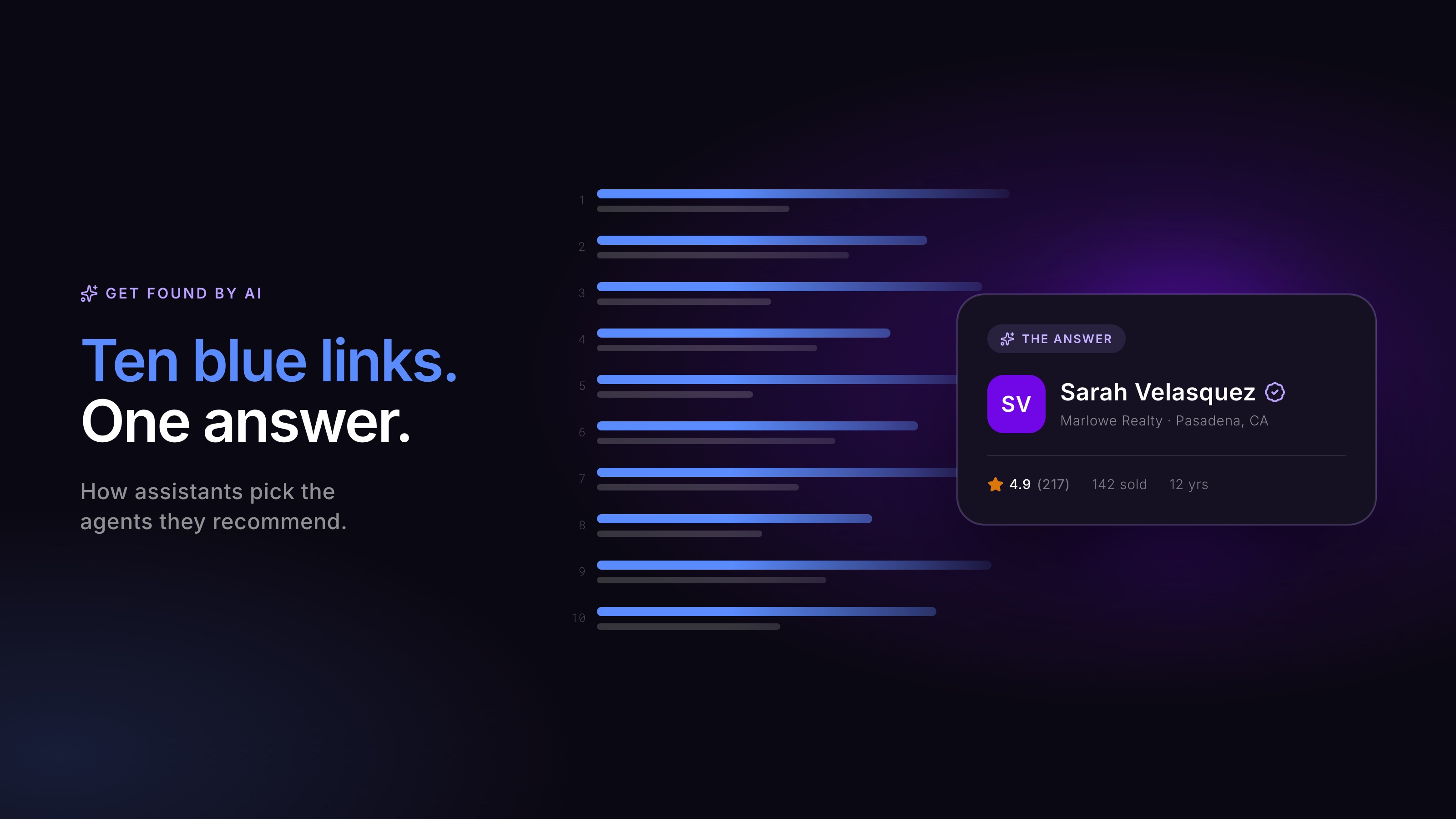
When someone asks an AI assistant for a local real estate agent, the response may mention only a few names. If your public profiles are incomplete, your reviews are stale, or the web contains conflicting information about you, the assistant has less reliable material to work with.
Getting found by AI is not a switch you can flip or a placement anyone can guarantee. It means building a clear, credible public presence that assistants can find and interpret. This guide covers five practical parts of that work: your Google Business Profile, reviews, local content, structured data, and a consistent identity across the web.
Why does AI visibility suddenly matter for real estate agents?
AI-assisted discovery now deserves a place in your marketing plan. ChatGPT reached 900 million weekly users as of OpenAI's February 2026 announcement, and Google reported that AI Overviews reach 2 billion monthly users on its Q2 2025 earnings call. Closer to home, BrightLocal's Local Consumer Review Survey 2026 found that 45% of consumers use generative AI tools for local business recommendations, up from 6% a year earlier. That made AI the third most-used source in the survey, behind Google and Facebook.
Real estate is following the same curve. A Veterans United survey from February 2025 found roughly one in three prospective buyers (32%) already using AI tools in their homebuying journey, with home search itself as the top use case (38%).
The important difference is the format. A traditional search page presents a ranked set of links, while an AI response may summarize the options and mention only a short list. That matters because many buyers speak with just one agent before choosing: in the NAR 2025 Profile of Home Buyers and Sellers, 67% of first-time buyers and 76% of repeat buyers interviewed exactly one agent. Appearing in an AI answer does not guarantee a call, but it can put you on a buyer's initial consideration list.
NAR's 2025 REALTORS® Technology Survey found that 20% of members used AI daily, while 32% had not used it in their business. Those figures measure AI use, not AI visibility work, but they show that agent adoption is still uneven. Building a strong public presence now can help you prepare as more buyers add AI to their research process.
How do AI assistants decide which agents to recommend?
AI assistants may draw from information learned during training, live web results, business directories, review platforms, maps, and other data sources. The mix depends on the product, model, settings, and query. For a local, time-sensitive question such as "who's a good listing agent in Frisco?", current web sources can be especially important when browsing or search is available.
AI visibility is closely connected to your existing web presence. The clearer and more consistent your business information is across profiles, reviews, your website, and reputable directories, the easier it may be for an assistant to identify you and describe your work accurately. No major assistant publishes a fixed formula for deciding which local professionals to mention.
What public signals can help AI understand an agent?
Because the platforms do not publish a shared ranking formula, treat the following as practical signals to strengthen rather than known ranking factors:
- Review volume, recency, and detail. Reviews provide public evidence of client experience, and consumers increasingly encounter them through AI summaries. BrightLocal found that 82% of consumers read AI-generated review summaries, while 42% trust AI recommendations as much as traditional reviews. A review that names the neighborhood, property type, and service provided offers more context than "Great agent."
- A complete Google Business Profile. For eligible agents, the profile gives Google a structured record of the business, including its category, service area, contact details, photos, and reviews. Other assistants may also retrieve information from Google or from pages that repeat those facts.
- Consistent identity across sources. Current, compatible information about your name, brokerage, phone number, and market reduces ambiguity. Material conflicts can make it harder for people and machines to determine which information is correct.
- Clear, factual content that answers real questions. A page that directly explains closing costs in your county is easier to understand and summarize than a page built mostly from broad claims about service.
- Structured data (schema). Appropriate markup can label details such as your name, service area, organization, and contact information. It helps parsers understand the page, but it does not guarantee inclusion in search features or AI answers.
One point is nonnegotiable: nobody can guarantee placement in an organic AI answer. The systems and their source choices change, and their selection methods are not fully public. What you can control is the quality of the information available about your business. For a practical way to inspect the results in your market, use our AI recommendation test. To understand how this work differs from traditional search, read AEO vs SEO for real estate agents.
How do you find out whether AI can see you today?
Ask the assistants the same questions a prospect might ask. Use a logged-out or private session where possible to reduce account-based personalization, while recognizing that location and other context can still affect the result. Try prompts such as:
- "Who are the best real estate agents in [your city]?"
- "I'm a first-time buyer in [your neighborhood]. Which agent should I talk to?"
- "Who's a good listing agent for a condo in [your market]?"
- "Tell me about [your name], real estate agent in [your city]."
Classify the result as named, known but not named, or not found or inaccurate. If an assistant can describe you accurately but does not include you in a recommendation, your identity is at least discoverable in that test. If it draws a blank or confuses you with someone else, start by checking the public sources that identify you. Treat each result as a snapshot, not a definitive score.
Run the full version of this check with our 30-minute AI visibility audit, which adds scoring and a fix-first priority list, or follow the ChatGPT experiment walkthrough to see what the answers reveal about your market.
What is the five-part AI visibility system?
The system is a complete Google Business Profile, a useful body of client reviews, clear local content, structured data on your site, and a consistent identity everywhere. These pieces reinforce one another: reviews strengthen your public proof, content shows your local expertise, and consistent facts make the full picture easier to verify.
1. Claim and complete your Google Business Profile
For an eligible agent, a Google Business Profile is a strong place to establish current local facts. Complete the fields that apply to your business: the correct primary category, actual service areas, hours, phone number, website, and representative photos. Use the business description to explain who you help, where you work, and what you specialize in, using plain factual language.
Two details deserve attention. First, if you meet Google's rules for an individual-practitioner profile, maintain a profile for your own practice rather than relying only on your brokerage's listing. Second, use posts and Q&A features where they are available and useful. Keep the information current, but do not create duplicate profiles or add keywords that are not part of your real-world business name.
2. Build a useful body of client reviews
Review count, recency, and detail all matter to prospective clients, and detailed reviews can give AI-generated summaries more context. Make an honest review request part of your closing process. You can invite clients to mention the neighborhood, property type, or part of the experience they found valuable without scripting their sentiment. "Navigated a tough appraisal gap on our first home in Oak Cliff" is more informative than "Great agent."
Build the process around your actual transaction volume. Ask at a natural moment, such as closing or a key handoff, send the direct review link, and use one polite reminder if needed. Respond thoughtfully to the reviews you receive. The goal is a steady, authentic record of client experience, not a sudden burst of generic feedback.
One bright line: do not offer incentives in exchange for Google reviews. That can violate Google's policies and put the reviews at risk.
The full review system, from profile setup and the initial ask to responses and removal rules, is in our Google reviews guide for agents. You can also use the copy-paste request scripts for each channel.
3. Publish content that answers local questions
Content is easier to extract when it answers a clear question directly. Use a descriptive heading, give the short answer first, and add context below it. Useful topics are often hyperlocal: "What is the average price per square foot in [neighborhood]?" or "What should first-time buyers budget for in [suburb]?" This is where an agent's current local knowledge can add something a national portal may not cover.
A practical starter set is one FAQ page for your primary market, one neighborhood guide per farm area, and a plain-language "how I work" page. Use questions clients actually ask. Include objective details such as housing stock, price bands, commute resources, links to official school information, your process, fees, and typical timelines. Add named places, dates, and sourced numbers where they help, then label updates so readers can judge how current the information is.
Do not outsource your judgment to generic AI-generated filler. One useful page grounded in your market is more valuable to a buyer than dozens of interchangeable "Top 10 reasons to live in [city]" posts.
4. Add structured data to your website
Structured data is machine-readable markup, commonly written as JSON-LD, that describes the content on a page. Depending on how the site represents an individual agent and business, appropriate types may include Person, Organization, LocalBusiness, or RealEstateAgent. Properties such as areaServed, url, and telephone can reinforce facts already visible on the page. Use FAQPage, Review, or AggregateRating only when the visible content and the platform's policies support that markup.
Ask your developer or website provider to add the appropriate markup, then validate the syntax with the Schema.org Validator. Google's Rich Results Test is useful only for structured-data types that Google supports as rich results. Your website remains the public source you control most directly, and it can bring your bio, listings, reviews, and contact details together in one place. Whether you need a full website or something lighter is its own question, but you need a stable page that clearly represents your business.
5. Keep your identity consistent everywhere
Audit every place your business appears: your website, Google Business Profile, Zillow, Realtor.com, state license lookup, Facebook, Instagram, and YouTube. Keep your name recognizable and make sure your brokerage, phone number, and markets are current. Minor formatting differences are usually harmless; conflicting affiliations or contact details are not. This matters most after a brokerage move, when old profiles can linger.
Consistency includes your bio. You may need a full version for your site and a shorter one for social profiles, but the underlying facts should agree. Start with one canonical version covering your markets, specialties, experience, and credentials, then adapt it without changing the substance.
What are the most common AI visibility mistakes?
The most damaging mistake is chasing tricks instead of building evidence. Hidden prompt text, keyword-stuffed "AI optimization" pages, and generic bot-written review responses do not make your business more credible. A clearer long-term strategy is to publish accurate information that is genuinely useful to clients.
The other frequent failures, in rough order of cost:
- Letting reviews go stale. A profile with no recent client feedback may look inactive or make it harder for a prospect to judge your current service.
- Treating this as one-and-done. Public information changes, and assistants may retrieve current sources each time they answer.
- Splitting your identity. Duplicate profiles, conflicting names, or an old brokerage affiliation make your business harder to identify accurately.
- Ignoring everything outside Google. Assistants use different and changing source sets, so keep relevant directories and industry profiles current too.
- Publishing volume instead of answers. A substantive page that answers a buyer's question is more useful than a batch of thin, lightly edited AI drafts.
How do you track AI visibility over time?
Build a simple monthly log. Run the same five to eight prompts in ChatGPT, Gemini, and Perplexity, then record whether you were named, whether the information was accurate, and which other agents appeared. The other names give you a useful comparison set. Review their public profiles for ideas, but do not assume any one visible feature caused the assistant to mention them.
Expect noise. Assistants can give different answers to the same question on different days, so do not overreact to one run. A wrong brokerage, stale phone number, or mixed-up namesake may point to conflicting or outdated sources. Check any citations the assistant provides, search for the incorrect fact, fix the source where possible, and test again later.
How long does it take to show up in AI answers?
There is no reliable universal timeline. A correction may appear once a source is recrawled or retrieved again, while broader reputation changes depend on how your public footprint develops and which sources an assistant uses. Re-run the same checks monthly, but judge the work first by whether your profiles and website are more complete, accurate, and useful.
Results also vary by market and prompt. A small suburb may produce a different set of sources than a major metro, and model or retrieval updates can change the answer without any action from you. That is why durable improvements such as accurate profiles, authentic reviews, useful content, and consistent facts matter more than a short-lived tactic.
Where does AgentsCard fit in?
Everything in this guide can be done manually, and the five-part system does not depend on a specific platform. AgentsCard's Get Found by AI brings several of the durable pieces together: an AI-ready microsite with structured markup, clear fields for reviews, listings, service areas, and specialties, plus mention tracking to help you monitor when assistants name you. You provide the accurate information, client experience, and local expertise; the platform helps organize them in a machine-readable profile.
To start without a platform, run the self-audit, correct your Business Profile, and put review requests on a repeatable schedule. Those steps can strengthen the foundation without turning the article into another software project. If you're wondering whether AI can answer your phone as well as help people find you, we cover that separate use case in AI voice assistants for real estate. For prompts that save time in your daily work, see 25 practical AI prompts for agents.