How to Respond to a Bad Review as a Real Estate Agent
Use a calm response framework and practical templates for common negative-review scenarios, including when a Google review may qualify for removal.
By Rajwinder Mahal
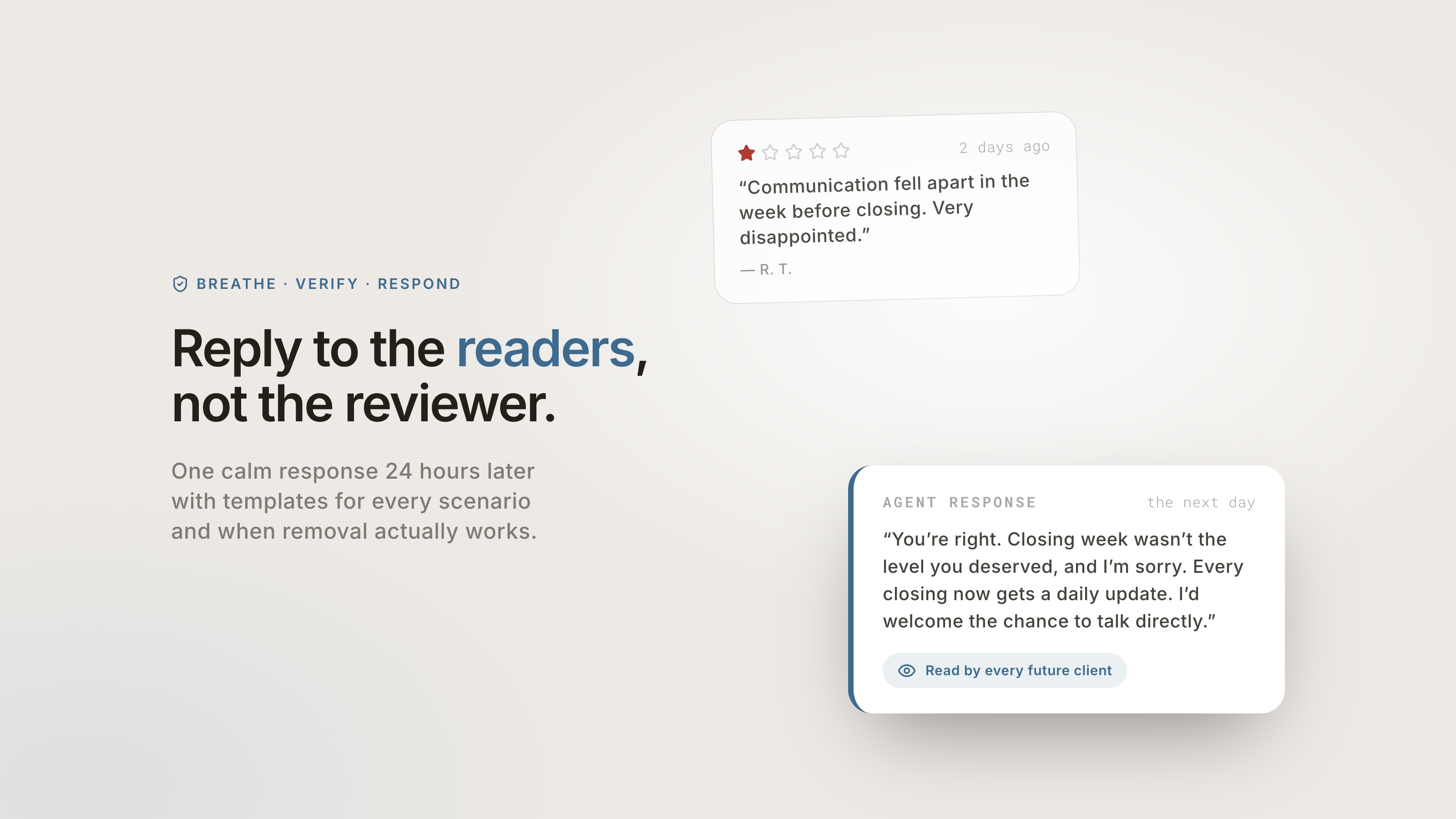
A bad review can make even an experienced agent want to respond immediately. Do not. Wait 24 hours, verify what happened, and then post one calm, factual reply.
Your response is not only for the reviewer. It also shows future clients how you handle problems under pressure. This guide walks through that process, provides templates for common situations, and explains when a Google review may qualify for removal.
Why respond at all instead of ignoring it?
Future clients reading the review will also read your response. In BrightLocal's Local Consumer Review Survey 2026, 89% of consumers said they expect businesses to respond to reviews, 80% said they are more likely to use a business that responds to all reviews, and 42% said they are unlikely to use one that ignores them. The same survey found that negative reviews deter 77% of consumers. A thoughtful response cannot erase the complaint, but it can add important context.
Speed matters, too. In the same BrightLocal survey, 19% of consumers expected a same-day response and 81% expected one within a week. A 24-hour cooling-off period still leaves time to respond promptly.
What is the breathe–verify–respond framework?
Breathe (24 hours). Criticism of your work can feel personal, and the first draft you write while upset is likely to sound defensive. Save it, but do not post it. A day gives you time to respond with a clearer head.
Verify. Review the transaction dates, messages, promises, and relevant notes before you write. Decide whether the complaint is substantially fair, partially fair, or does not appear to come from a genuine client. Each situation calls for a different response.
Respond once, with future readers in mind. Keep the reply to two to five sentences. Acknowledge the concern, state your position calmly, move real issues to a private channel, and stop. If the reviewer responds angrily, do not continue the public debate.
One rule is especially important in real estate: never share confidential transaction or client information in a public response. Avoid prices, terms, addresses, financing issues, and personal circumstances, even when the reviewer mentions them first. "I remember this transaction differently" protects privacy; "the deal fell apart because your financing collapsed" does not. Follow applicable laws, ethics rules, and your broker's guidance.
What should you write? Templates by scenario
Use these as starting points, then personalize them. According to BrightLocal, 50% of consumers said generic or templated responses frustrate them. If drafting is what slows you down, AgentsCard can draft a reply for you to edit before posting.
The fair complaint (you dropped a ball):
"You're right, [name]. My communication in the week before closing wasn't at the level you deserved, and I'm sorry. [One sentence on what you've changed: 'I've since moved every closing week to a daily-update system.'] I appreciate you saying it plainly, and I'd welcome the chance to talk directly: [phone/email]."
Own the mistake, name the fix, and invite a private conversation. The response shows future readers that you take responsibility and improve your process.
The partially fair complaint (real frustration, missing context):
"Thank you for the honest feedback, [name]. The market stretch was genuinely frustrating, and I'm sorry the experience fell short of what you'd hoped. Some of what happened came down to factors outside either of our control, and I remember parts of this differently, but your disappointment is real and I take it seriously. I'd rather talk it through than debate it here: [contact]."
Acknowledge the frustration, note calmly that you remember parts of the situation differently, and move the conversation offline.
The wrong-target review (they never worked with you, or meant another business):
"I take every review seriously, but I have no record of working with you, and I believe this may be intended for a different business or agent. If I'm mistaken, please contact me directly at [contact]. If this was posted in error, I'd be grateful if you could remove or repost it to the right place."
This stays calm and factual while giving future readers useful context. Flag the review for removal at the same time, using the process below.
The suspected fake (competitor, ex-vendor, someone with an axe):
"This review doesn't match any client or transaction in my records. I've reported it to Google for review. If you're a genuine past client, please reach me at [contact] so I can look into your experience directly."
Do not accuse a specific person of posting a fake review. You may not be able to prove it publicly, and the accusation can create a second reputation problem.
The rant with a nugget (hostile tone, one real issue inside):
"There's a lot here I see differently, but you raise one fair point: [the nugget]. On that, you're right, and here's what I've changed: [fix]. I'm glad to discuss the rest directly: [contact]."
Extract the legitimate issue, respond to that, let the hostility speak for itself.
When might Google remove a review?
A review may qualify for removal when it violates Google's content policies. Honest criticism from a real client does not qualify simply because it is harsh or feels unfair. Google says explicitly not to report a review only because you disagree with it or dislike it. Examples of content that may violate the policy include:
- Fake or paid content — reviews not based on a genuine experience, purchased reviews, review-bombing campaigns
- Conflict of interest — reviews by competitors, current or former employees, or anyone with a professional or personal stake
- Off-topic content — rants about politics, someone else's business, or anything other than an experience with yours
- Harassment, hate speech, or personal attacks — including unsubstantiated accusations of crimes
- Personal information — posting someone's address, phone number, or other identifying details
- Spam, profanity, and restricted or illegal content
Flag the review from your Business Profile or use Google's Reviews Management Tool, which lets you report reviews and track their status. Google's review can take several days. If the decision comes back "no policy violation" and you believe it is wrong, the tool may offer a one-time appeal. Make that appeal specific and evidence-based. Never offer the reviewer anything in exchange for removing the review; that can violate Google's policy and the FTC's review rule.
While the report is pending, consider posting the wrong-target or suspected-fake response above. Removal is not guaranteed, so a measured public reply remains the part you control.
How do you turn a bad review into a trust signal?
Build a steady collection of honest, specific reviews and let your response show how you handle criticism. The arithmetic helps put one poor rating in perspective: if 30 reviews average 4.9 stars, adding one one-star review lowers the average to about 4.77. With fewer reviews, a single low rating has a larger effect. A consistent review collection system gives prospects a broader view of your service. If your count is low, here's what "enough" looks like and how to get there.
Finally, treat a fair complaint as process feedback. Communication often breaks down during the most stressful parts of a transaction, so look for a specific change you can make. Mentioning that change in your response shows future readers that you take feedback seriously. For the full reputation system, see the complete guide to Google reviews for agents.