
8 Real Estate Agent Bio Examples That Build Trust
Use eight annotated examples and a simple fill-in formula to write a clear, credible agent bio for prospective clients and online discovery.
By Rajwinder Mahal
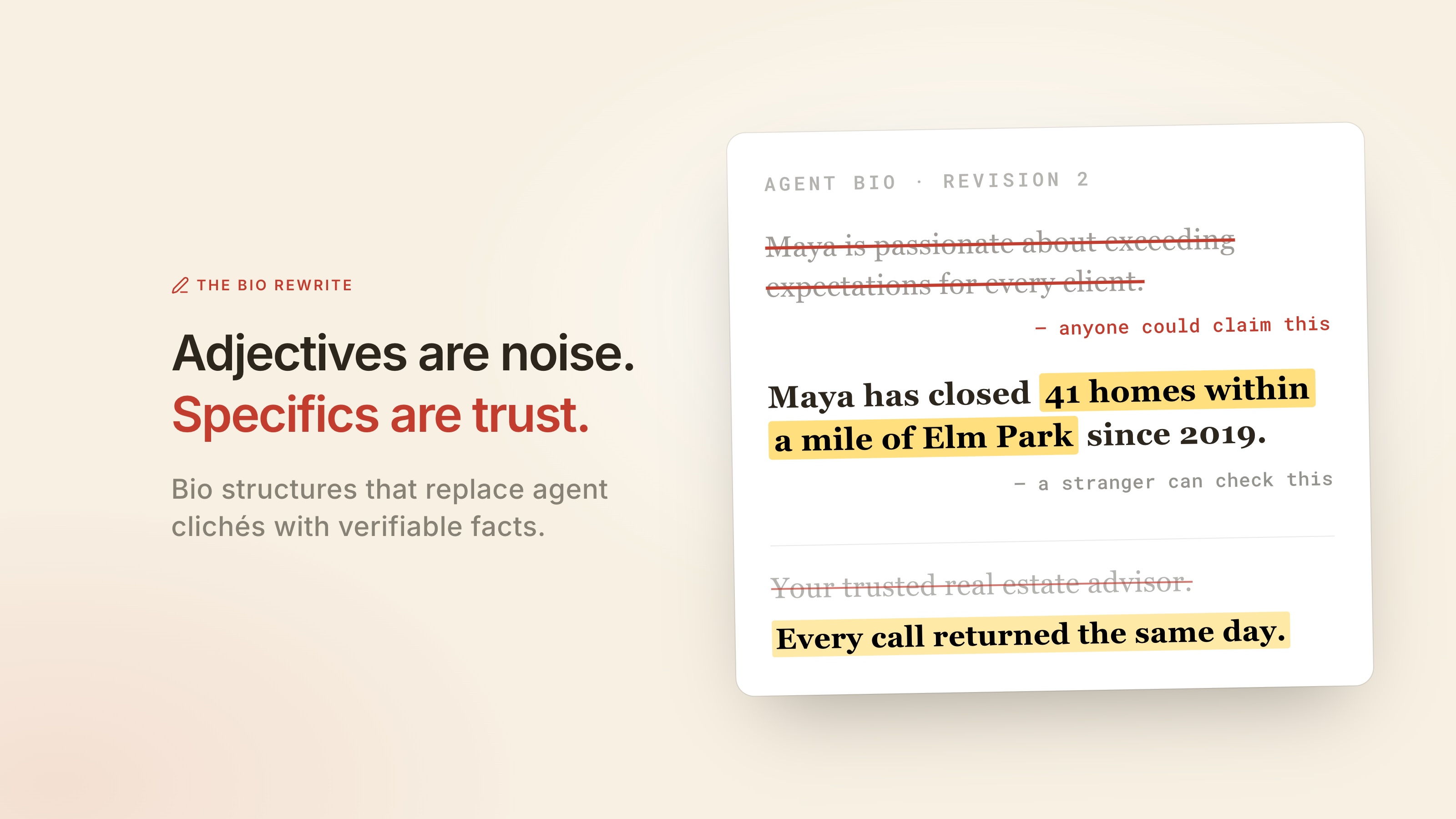
A strong real estate agent bio trades generic adjectives for useful evidence. Instead of saying you are "passionate about exceeding expectations," show readers the markets you serve, the experience you bring, and how you work. This guide gives you a five-part formula, eight annotated examples, and a list of clichés to cut. It also explains how a clear, consistent bio helps prospective clients evaluate you and makes your professional information easier for search and AI systems to understand. Every example below is a fictional composite created to illustrate a structure; none describes a real agent.
What makes a real estate agent bio actually work?
Start with one useful principle: specifics build trust; adjectives rarely do. In NAR's 2025 Profile of Home Buyers and Sellers, sellers' top criteria for choosing an agent were reputation (35%) and honesty and trustworthiness (22%). A reader cannot verify "dedicated professional," but they can verify "37 sales in Ballard and Fremont over the last three years." Your bio should present credible specifics quickly. Because 74% of buyers interviewed exactly one agent, it needs to give prospective clients enough confidence to start a conversation.
The working formula, in five sentences' worth of jobs:
- Position - who you serve and where, in one sentence. Specific positioning is usually easier to understand.
- Proof - the two or three most credible facts you own: transactions, years, credentials, rankings you can back up.
- How you work - one or two process specifics a client would actually feel ("responds to every inquiry the same day," "walks every listing before recommending an offer price").
- Human detail - one, and only one, genuinely personal fact. It makes you memorable and confirms you're a person.
- Invitation - how to start, without pressure.
Aim for about 120 words for the canonical version. You'll cut it down for platform limits, never pad it up.
8 real estate agent bio examples, annotated
Each example below is a structure you can borrow, with a note on why it works and who should use it. All names, numbers, and markets are invented for illustration.
1. The neighborhood specialist. "Maya Chen helps buyers and sellers in Riverton's tree-street neighborhoods and has closed 41 homes within a mile of Elm Park since 2019. A Riverton homeowner herself, she publishes the neighborhood's only quarterly price-per-square-foot report and previews every new listing in the area within 48 hours. Clients mostly hear about Maya from their neighbors; she'd be glad to show you why." This is a useful general-purpose structure: place, transaction count, and a detail that demonstrates local focus. Use it if you can name a geography where your numbers are concentrated.
2. The numbers-forward producer. "Dan Okafor has sold 340 homes across Westfield County in 12 years, with an average of 11 days on market compared with the county's 26. He prices from data, negotiates in writing, and tells clients the truth even when it costs him the listing." This version is direct, quantified, and listing-oriented. Use only numbers you can support if a client asks. Rounding up turns an apparent strength into a credibility problem.
3. The first-time-buyer educator. "Priya Raman has guided more than 90 first-time buyers from open house to keys, most of them convinced they couldn't buy yet. Her buyer bootcamp includes lender introductions, a written 90-day plan, and a no-question-is-embarrassing policy. She created it because she remembers being terrified by her own first closing." This structure presents expertise through teaching, which is valuable to first-time buyers. The personal detail adds meaning, but it needs to be true.
4. The relocation specialist. "After three corporate relocations of her own, Sofia Martinez built her practice around people moving to Harborview sight unseen. She offers video tours within 24 hours, school and commute briefings, and a settling-in list her clients still use a year later. Half her business comes from HR departments that send her their new hires." Here, personal history becomes a relevant credential. Use this structure when your story explains your niche.
5. The second act. "Before real estate, James Whitfield spent 15 years as a general contractor, so when he walks a listing, he sees the furnace, not the staging. His inspection eye has helped buyers identify expensive concerns and sellers focus on the right repairs before listing. Licensed since 2021, he treats every walkthrough like a job site: show up early, tell the truth, and finish what you start." This structure helps career changers turn relevant prior experience into proof. It can work for teachers, nurses, military professionals, lenders, and others with transferable expertise.
6. The team lead. "The Nguyen Group closed 128 transactions across Lakeside last year with a simple division of labor: Linh Nguyen leads pricing and negotiation on every deal, while a dedicated coordinator keeps your paperwork moving daily. You get a 14-person team's coverage and one accountable name." This version addresses a common concern about teams by explaining who remains responsible for the client experience.
7. The newer agent. "Aisha Bell grew up over her family's diner in South Rockford and knows the town the way only a local can. Licensed in 2025 with Rockford Realty, the office that closed more South Side homes than any other brokerage last year, she caps her client load so every buyer gets first-showing speed and backs every deal with her managing broker's 20 years of contract experience." With no production history yet, use proof you can support: local roots, brokerage strength, relevant prior experience, and the practical advantages of a smaller client load. Never invent numbers, and verify any brokerage-level claim before publishing it.
8. The listing specialist. "Marcus Hale sells houses that previously failed to sell. Of his last 60 listings, 23 came to him after expiring with another agent, and 21 closed. His method is straightforward: honest pricing conversations, professional staging and photography in the first week, and a written weekly report on showings and feedback. If you want the higher number, he'll first show you what it may cost in days on market." This niche is defined by a specific problem. The ratio carries the example, so a real version must use current, accurate numbers.
Which bio clichés should you cut?
Any phrase that could appear unchanged in a competitor's bio is doing little for yours. Common examples include "passionate about real estate," "dedicated to exceeding expectations," "helping you find your dream home," "whether you're buying or selling," "treats every client like family," "your trusted real estate advisor," and "unparalleled service." These phrases are hard to verify, while trust grows from claims a reader can check. For each cliché you cut, add one truthful, specific fact. If accurate, "passionate about the North End" might become "walked 200 North End listings in the last two years." The sentiment stays, but the evidence becomes concrete.
First person and third person can both work. Third person is common on websites and brokerage pages, while first person can feel natural on social profiles. Choose one voice for each version and use it consistently. Instead of promising "great communication," describe the standard you actually follow, such as "every call returned the same business day."
Where does your bio live — and why must every copy match?
Your bio does its work in more places than your website: your Google Business Profile description, Zillow and Realtor.com profiles, Instagram and Facebook bios, LinkedIn, your email signature, and the brokerage roster page. Two rules help keep those versions aligned. First, write one canonical version, then cut it to fit each platform rather than starting over every time. Second, keep the facts consistent, including your name format, brokerage, markets, and production numbers. This is why reviewing every bio is a named step in the switching brokerages checklist. A move can leave old profiles contradicting your current information.
Consistency matters to both people and automated systems. Clear, matching public facts make your identity, service area, and experience easier to interpret. Conflicting details can create uncertainty. A canonical bio is one of several public signals that may help you get found by AI systems, and keeping it current is part of the agent website and personal brand playbook. If drafting is the blocker, use the bio-rewrite prompt in our AI prompts collection to turn your fact list into a starting draft, then verify every claim and rewrite it in your voice.
On an AgentsCard microsite, the bio sits alongside structured details such as markets, credentials, reviews, and listings. That organization makes the information easier for people, search engines, and AI systems to interpret. Whether you need a full website around it is a separate question.