
How to Build a Real Estate Referral System That Lasts
Build a practical referral system with a reliable touch plan, natural asks, simple tracking, and stronger agent-to-agent relationships.
By Rajwinder Mahal
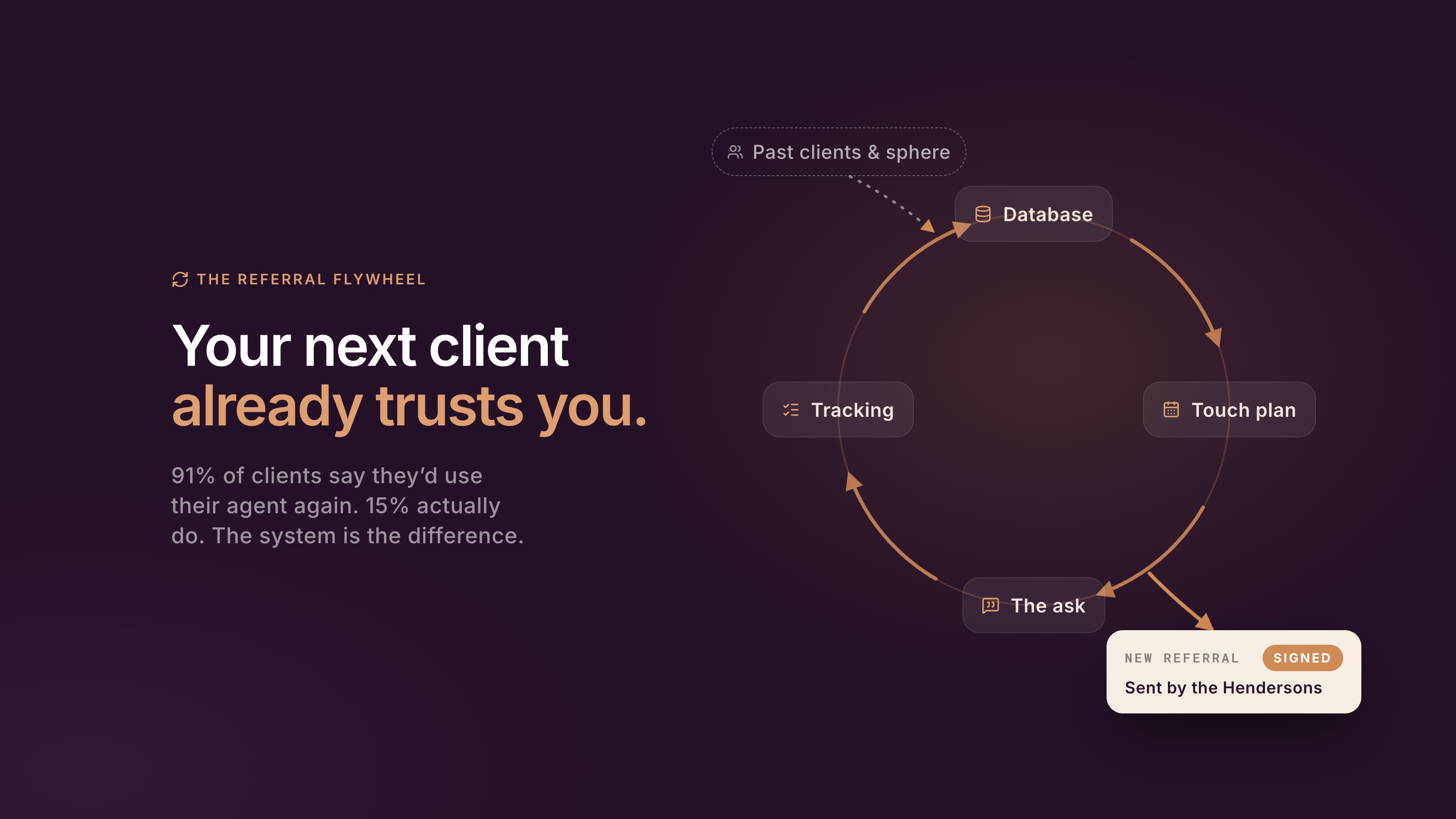
Referrals feel unpredictable when staying in touch lives on a mental to-do list. Past clients sit in your phone, follow-up happens when business is slow, and introductions are easy to lose once the week gets busy.
A practical referral system fixes that with four connected pieces: a clean database, a consistent touch plan, a natural way to ask, and simple pipeline tracking. This guide shows you how to build each one, including how to handle agent-to-agent referrals and what to automate.
Why do referrals remain a major source of business?
Referrals remain central because many clients choose an agent through an existing relationship. In the NAR 2025 Profile of Home Buyers and Sellers, 43% of buyers found their agent through a friend, neighbor, or relative, and another 15% used an agent they'd worked with before. Together, referrals and repeat relationships accounted for well over half of buyer-agent matches. Among sellers, 66% either hired an agent referred to them or returned to one they'd used before.
The same pattern appears in NAR's member research. In NAR's 2026 Member Profile, the typical member earned 28% of their business from past clients and customers, up from 20% the year before. Among agents with more than 16 years of experience, repeat business alone accounted for about half of their business. The prior year's profile measured referrals separately: a median 21% of business came through past-client referrals, while agents with 16 or more years of experience reported 41% repeat business and 28% referral business.
Referrals also begin with something most cold leads do not: transferred trust. The introduction does not guarantee a client, but it can make the first conversation warmer and more productive.
Why can referrals be easier to convert than cold leads?
Many consumers speak with only one agent before deciding. In the same NAR profile, 74% of buyers interviewed exactly one agent, and 80% of sellers contacted only one. A strong referral can help you become that first conversation. With a purchased portal lead, by contrast, you may be competing with several agents trying to reach the same person.
Before calling, a referred prospect may search your name. Your reviews, website, and recent activity can reinforce the recommendation or create doubt. That is why referral and reputation systems work well together; the complete guide to Google reviews covers the reputation side. Some consumers also use ChatGPT and AI search tools during their research, making consistent public information increasingly useful. Getting found by AI explains that process in more detail.
Purchased leads can still help fill a thin pipeline. The useful comparison is cost per closed deal, including the time you spend following up. Referrals require steady relationship work, but they often begin with more trust and can lead to future introductions.
What is a real estate referral system?
A referral system helps close the gap between a client's good intentions and their next introduction. According to NAR, 91% of buyers say they would use their agent again or recommend them, yet only 15% used an agent they'd worked with before. Among sellers, 29% returned to a previous agent. Many factors contribute to that gap, but staying visible gives past clients a better chance of remembering your name when they or someone they know needs help.
The system has four parts, and every section of this guide maps to one:
- A complete, usable database. Keep every past client, sphere contact, and vendor relationship in one place, along with the details that make personal follow-up possible: closing anniversary, home information, family notes, and how you met.
- A touch cadence. Use a written annual plan that keeps you visible between transactions instead of relying on memory.
- A natural ask. Deliberate moments and wording that invite referrals without turning every conversation into a pitch.
- Pipeline tracking. Referrals treated like deals: sourced, staged, followed up, thanked, and measured.
The goal is consistency, not more hustle. Every closing adds to your future referral base only if you have a reliable way to maintain the relationship.
How do you build the database the system runs on?
Consolidate first, then add detail over time. Many agents have contacts spread across a phone, an email account, transaction files, a holiday-card list, and an old CRM. Start by bringing every past client and genuine sphere contact into one system, removing duplicates, and noting the source of each relationship.
Then enrich the records that matter, because the touch plan runs on fields, not names. The ones that earn their keep:
- Closing anniversary — a useful date for personal, relevant follow-up.
- Home details — address, property type, and purchase price, which add context to home-value updates and anniversary messages.
- Personal notes — kids, pets, jobs, or the kitchen they planned to renovate. Brief notes at closing make later conversations more personal.
- How you met — the source field you need to calculate your referral rate.
- Priority tier — a simple way to decide who receives personal outreach and who receives broader updates.
Add missing details gradually. Complete the records for your highest-priority contacts first, then update everyone else one conversation at a time. A few seconds of note-taking after each check-in is enough. Keep an exportable copy of your database, too. Contacts stored only in a brokerage-provided system can be difficult to take with you when agents move.
What if you haven't touched your database in years?
Start with one honest touch, then move into your regular cadence. You do not need a long apology or an elaborate explanation. A practical sequence looks like this:
- Reconnect honestly. Call or send a personal note: "It's been far too long since I checked in. That's on me. How has the house been treating you?" Skip the newsletter, pitch, and long explanation. Acknowledge the gap, then move the conversation forward.
- Offer something useful within a month. A home-value update is a natural option: "Happy to send an updated read on what your place is worth. No agenda." It gives the client relevant information and brings the relationship back into the present.
- Add them to the calendar. From there, move them into your regular touch plan. Do not try to make up for several quiet years with a burst of messages. The goal is a steady, useful presence.
Work through the reactivation list in manageable batches, such as ten contacts a week. That pace makes it easier to personalize each conversation and keep the routine going during busy months.
How do you build the annual touch plan?
A practical starting point is roughly one touch a month per contact. A touch should feel personal or useful: a call, a handwritten note, a relevant market update, a home-anniversary text, or an event invitation. Twelve touches can become a manageable calendar with a few personal moments, several seasonal or broadcast updates, and one or two in-person events.
Two rules make the plan practical. First, write the calendar once and reuse it; only the personalization changes. Second, match the level of outreach to each tier. Likely referrers may receive the full personal cadence, while your broader sphere receives useful updates. The complete month-by-month calendar, with scripts for each touch and a segmentation model, is in the past-client follow-up plan.
Consistency matters more than complexity. A modest plan you can maintain all year is more useful than an ambitious one you abandon by spring.
How do you ask for referrals without being awkward?
Ask at the right moments, be specific, and remove any sense of obligation. A generic "know anyone looking to buy or sell?" can feel transactional. These adjustments make the conversation more natural:
- Time it to emotional peaks. Closing day, the offer acceptance call, the moment a client thanks you unprompted. Gratitude is the natural opening: "That means a lot — the best compliment in this business is an introduction to someone you care about."
- Make it specific. "If anyone on your street mentions selling this spring, I'd love to be the name you give them" gives the client a clear situation to think about.
- Set the expectation early. At the first meeting, you might say: "Most of my business comes from people my past clients send me, and that's the standard I work to." The closing-day ask then feels like a natural follow-up instead of a surprise.
- Pair it with the review ask, not in the same breath. Closing day carries one ask well. Send the review request the same day (wording in our review request scripts), and let the referral ask ride the anniversary and check-in touches that follow.
Be careful about paying for referrals. A fee or gift to an unlicensed person may violate state law or brokerage policy, depending on how it is structured. Check your state's rules and your broker's policy before offering anything of value. When in doubt, ask your broker or an attorney.
How do you track referrals like a pipeline?
Track the source, stage, next action, and outcome just as you would for a deal. Introductions are easy to lose when they happen by text and no one logs the next step. Create a record as soon as the referral arrives:
- Source everything. Give every new contact a permanent "how they found me" field. This makes it possible to see how much business your referral system generates.
- Stage the handoff. Introduced → contacted → met → active → closed → thanked. Aim to respond to the introduction the same day. Quick follow-up reassures the referrer that you value their trust.
- Close the loop with the referrer. Send a quick "we connected today, thank you again" when the conversation starts, followed by a genuine thank-you when the transaction closes. Keeping referrers informed shows that you value the trust they placed in you.
- Measure two numbers each quarter. Track referrals received and your referral rate (referrals ÷ active database contacts). Watch the trend over time to decide whether your touch plan needs work.
How do agent-to-agent referrals fit in?
Agent-to-agent referrals are the professional side of the same system. In the NAR profile, 7% of buyers and 4% of sellers found their agent through a referral from another agent or broker. An agent whose client is leaving your market may need a trusted partner in the destination market, while an out-of-market agent may need someone reliable in yours. Referral fees are typically handled through brokerages under a written agreement, but the requirements vary by state and brokerage.
Building that network involves relocation partnerships, staying visible to out-of-market agents, written fee agreements, and consistent follow-through. The full playbook is covered in agent-to-agent referrals.
Can client appreciation events support referrals?
They can, especially when they are part of your regular follow-up plan. The invitation, reminder, in-person conversation, and follow-up photo each create a genuine reason to reconnect without making a sales pitch. NAR found that 62% of recent buyers had recommended their agent within a year of closing, as had 65% of sellers. Events give satisfied clients another experience to remember and talk about.
Invitations and prompt follow-up are just as important as the event itself. Formats by budget tier, from a small coffee-shop gathering to an annual client party, are in client events that generate referrals.
How do you automate the cadence without losing the personal touch?
Automate the reminders, but keep the relationship personal. Use software to surface who needs attention and why, then write or approve the actual message yourself. A calendar and spreadsheet can support a small database. A CRM reduces the manual work by storing anniversaries, tracking referral stages, and reminding you when a contact has gone quiet.
AgentsCard's Referral Engine follows that division of labor. It keeps your sphere in one place, sorts contacts by last touch, provides date-based reminders and editable message drafts, and tracks referrals after an introduction. You stay in control of every message while the system helps prevent important relationships from going quiet. The product is currently available through a waitlist on the product page.
Whatever tools you use, the principle is the same: referral relationships benefit from steady attention long after closing. Build a process you can maintain, then keep showing up.