
Real Estate Lead Generation in 2026: Sources, Costs, and Follow-Up
Compare the costs and tradeoffs of major real estate lead sources, see why relationships matter, and build a follow-up system that gives each lead a fair chance.
By Rajwinder Mahal
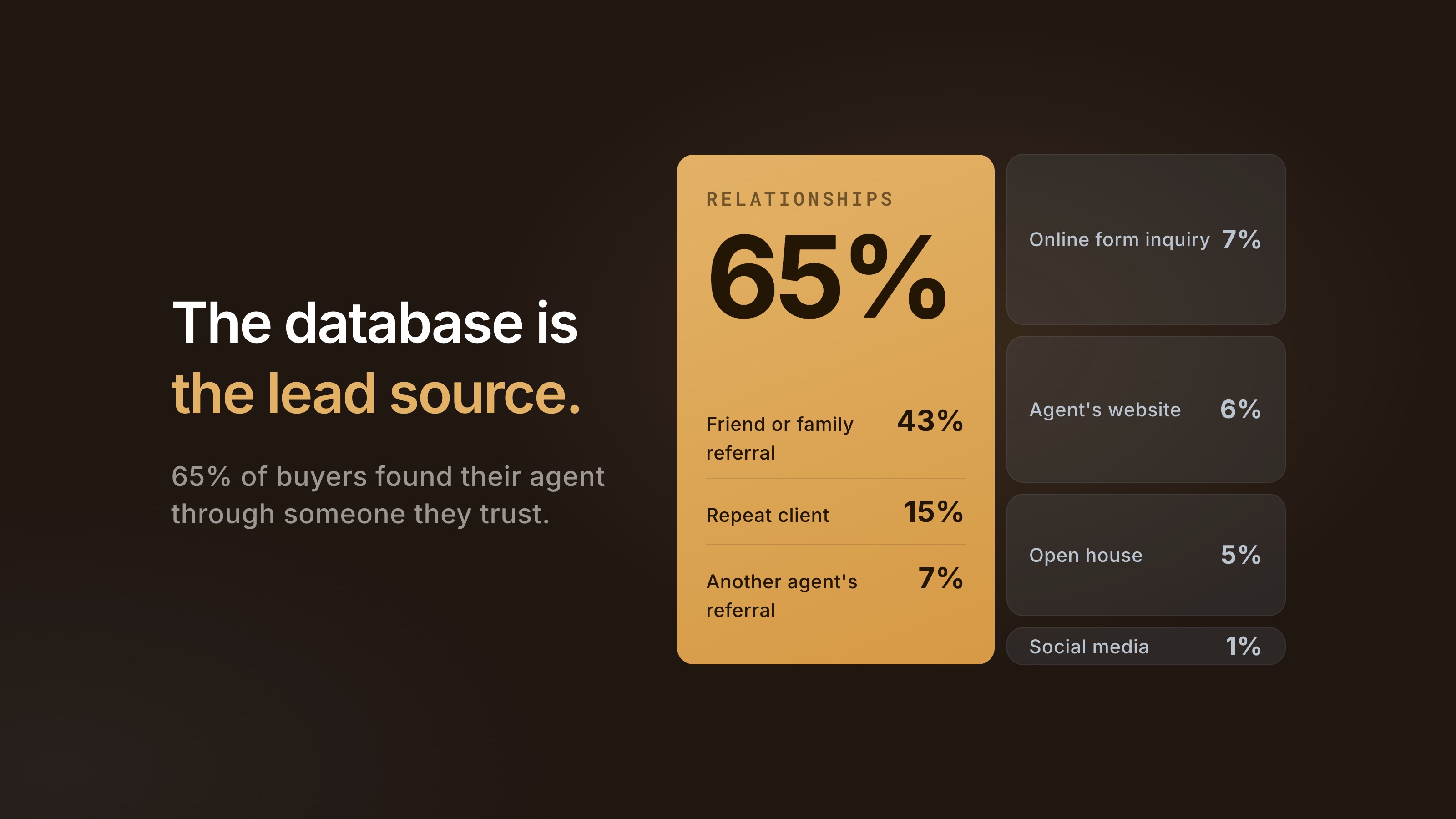
The best real estate lead strategy is rarely a single channel. In the NAR 2025 Profile of Home Buyers and Sellers, 65% of buyers found their agent through a referral, a past relationship, or another agent, while 7% found one by inquiring about a property online. Paid sources can create opportunities, but the result still depends on how quickly and consistently you follow up. This guide compares the cost and quality tradeoffs of the major lead sources, explains the value of relationship-driven business, and shows how to manage speed, cadence, and pipeline stages after a lead arrives.
Where do real estate leads actually come from?
Relationships account for the largest share. NAR reports that 43% of buyers found their agent through a friend, neighbor, or relative, 15% used an agent they had worked with before, and 7% were referred by another agent. By comparison, 7% found their agent by inquiring about a specific property online, 6% through a website, 5% at an open house, and roughly 1% through social media alone.
Agents' own reporting adds useful context. In the NAR 2025 REALTORS® Technology Survey, the technologies members said produced the highest number of quality leads were social media (39%), their CRM (23%), and the local MLS (17%). Listing syndication and portals came in at 9%, behind agents' websites (12%) and email marketing (11%). These are different datasets measuring different things, but together they suggest that social media and CRM activity can support the relationships that later show up as referrals and repeat business. Think of the database as the center of the system, with other channels feeding it.
Paid leads can still play a useful role, especially while referral and repeat-business channels are developing. The key is to treat them as one part of the strategy and measure them by closed business rather than lead volume alone.
What does each lead source really cost?
Every source costs some combination of cash up front, commission at closing, and time. A useful comparison accounts for all three. Dollar figures vary widely by market, so broad cost-per-lead averages may not reflect what an agent will actually pay. Start with each source's pricing model and the type of opportunity it tends to create.
| Source | How you pay | Quality profile |
|---|---|---|
| Portal advertising | Monthly ad spend; on Zillow, priced per ZIP by demand and your share of voice | Can provide volume and early-stage shoppers; fast response is especially important |
| Portal referral programs | Nothing up front; a success fee paid from commission at closing (e.g., Zillow Flex) | Terms and connection quality vary; a closing fee reduces net commission |
| PPC and social ads | Cash per click or impression, plus landing pages and management time | Offers targeting control and direct inquiries, but conversion can take time |
| Open houses and sign calls | Time, and the listing that powers them | In-person trust head start; 5% of buyers found their agent at an open house |
| Geographic farming | Sustained mail/content spend over years | Slow to start and requires long-term consistency |
| Sphere, referrals, past clients | Time and a touch system; usually minimal cash | Existing trust can produce warmer conversations and repeat opportunities |
Two of these models deserve a closer look because they charge differently. Under the terms described in the linked program pages, Zillow Premier Agent is advertising purchased in a ZIP code, with pricing influenced by local demand, while Zillow Flex uses a success fee paid from commission when a connection closes. Terms and rates can change by market, so check the current program documents and include the full cost in your per-deal calculation.
What agents actually budget is often modest: in NAR's technology survey, 24% of members spent less than $50 a month on lead generation over the past year, 27% spent $50–$250, and 19% spent more than $500. A modest budget paired with disciplined follow-up can be more effective than larger spending without a clear response and nurture process.
Why do referrals deserve more attention?
The economics of relationship-driven business are compelling. NAR's 2026 Member Profile found that the typical member earned 28% of their business from past clients and customers, up from 20% the year before. The buyer data helps explain the appeal: 74% of buyers interviewed exactly one agent, and buyers typically contacted just one before getting a response. A referred prospect may begin with more trust than someone encountering you for the first time.
The economics can improve after the first transaction, too. NAR found that 91% of buyers would use their agent again or recommend them, and 62% had already recommended their agent within a year of closing. A client who came from a portal, sign call, or open house can become part of your long-term network when the follow-up system keeps the relationship active. Building that system, including the database, a twelve-touch cadence, the referral ask, and tracking, is covered in the real estate referral system guide.
Reputation also affects how prospects evaluate a referral. Before calling, a buyer may check your reviews, search for your name, or ask an AI assistant for information about you. A strong set of Google reviews and clear, consistent information that supports AI-search visibility can make that research easier.
What are the best lead generation ideas when the budget is small?
Focus on sources that cost time instead of substantial cash, and connect each one to your database. The most useful options can keep supporting your business after the initial work is done.
- Treat open houses as a channel, not a favor. They primarily cost time, put you face to face with prospective buyers, and support both your pipeline and your seller's marketing plan. The opportunity develops through follow-up, not only at the door.
- Build your review profile deliberately. Referred clients and portal shoppers often use reviews to evaluate you, and public review content may also help AI systems understand your reputation. A consistent review request system supports lead generation as well as credibility.
- Publish neighborhood-level content. A genuinely useful page about the areas you serve can reach relocating buyers early and make your local expertise easier for search engines and AI systems to understand.
- Use social media to build direct relationships. In NAR's technology survey, 39% of members named social media as the technology that produced the most quality leads. Give interested viewers a clear way to become contacts you can follow up with.
- Host a client event. A modest annual gathering can reactivate your sphere without a large media budget. The budget-tiered formats include options starting around a few hundred dollars.
These approaches usually take time to produce results. Paired with a modest paid budget for more immediate opportunities, they can build a stronger base of repeat and referral business.
Why do leads die in follow-up?
Slow response and inconsistent follow-up are common failure points. Research published in Harvard Business Review (Oldroyd, McElheran, and Elkington, 2011) examined 1.25 million sales leads. Companies that attempted contact within an hour of an inquiry were nearly seven times as likely to qualify the lead as those that tried even an hour later, and more than sixty times as likely as those that waited 24 hours. The same team audited 2,241 U.S. companies with a live web lead. Only 37% responded within an hour, the average response took 42 hours, and 23% never responded at all.
The study was not specific to real estate, but it illustrates the cost of delayed responses. A portal inquiry may be visible to several agents, and the shopper is often still looking at the property when the request arrives. NAR reports that most buyers interviewed only one agent, so a delay can cost you the chance to have that conversation. Coverage patterns for a solo agent, useful auto-responses, and first-call scripts are covered in the speed-to-lead guide.
Speed can start the conversation, but some prospects will not be ready to transact for months. A useful, permission-based follow-up plan helps you stay available without crowding them. That requires a system, not a burst of calls in the first week.
What does a good lead follow-up system look like?
Use one rule and four cadences. The rule is simple: acknowledge new leads quickly, make a same-day personal contact when possible, and assign a defined sequence after that. The cadence should reflect how the lead arrived and what they asked for:
- Portal and website inquiries. Respond in minutes, answer the question about the property, then ask about the prospect's broader search. A practical first-week sequence includes contact attempts on days 1, 2, 4, and 7 across calls, texts, and email. If there is no answer after a week, move the lead to an appropriate long-term nurture sequence.
- Open house guests. Same-day thank-you text while you're still the agent they just met, then a 7-day cadence segmented by what they told you at the door. The complete sequence, including the post-settlement buyer-agreement conversation, is in open house follow-up.
- Sign calls and direct inquiries. These often carry immediate intent because the person may be standing in front of the property. Answer live when possible. When you cannot, call back promptly and send a text with the property details.
- Sphere and referrals. Use a relationship cadence rather than a sales sequence. Respond the same day, arrange a personal conversation promptly, and thank the referrer. Long term, these contacts can move into the twelve-touch annual plan.
The connective tissue is a set of written sequences that does not depend on memory. Permission-based email and text nurture helps you stay in touch with leads who do not answer immediately. Six sequences segmented by lead type are included in real estate drip campaigns, along with an overview of CAN-SPAM and TCPA considerations. Confirm current requirements with your broker or legal counsel before automating outreach.
What pipeline stages should you actually track?
Use stages that mirror how your deals actually move. For many agents, eight stages are enough: new → attempted → connected → appointment → agreement signed → active → under contract → closed, plus a nurture lane for leads who are real but not ready. Written buyer-agreement requirements vary by brokerage, market, and transaction context, but the agreement is now a distinct stage for many agents before a home tour. Follow your current brokerage and MLS rules. The buyer agency agreements guide covers how to present that step clearly.
Two habits make the stages useful. First, give every lead a next action and a date so opportunities do not sit indefinitely. Second, keep the original source attached to every lead, because source data makes the measurement in the next section possible. If your current tool makes either task difficult, use the 12 questions to ask before buying a CRM to evaluate alternatives.
How do you measure what a lead source is worth?
Start with cost per closed deal, not cost per lead alone. Cost per lead tells you what it took to create an inquiry; cost per closed deal shows what the source contributed to actual business. You can run this formula quarterly in a spreadsheet:
Cost per closed deal = (cash spent on the source + hours spent × your hourly value) ÷ deals closed from that source.
The mechanics matter less than the habits behind them. Tag every lead with a source when it enters your pipeline, log the outcome when it leaves, and count time honestly. Twenty hours a month following up with portal inquiries is a cost even when no invoice arrives. Review the math over two or three quarters. A source that looks inexpensive per lead may be costly per closing, while a sphere-based source with little cash expense may perform better than expected. Commission-fee models such as Flex belong in the same calculation because the success fee is still a cost of closing the deal.
The goal is not to find one perfect source. It is to build a balanced mix of paid opportunities, farming, open houses, and consistent work with the database you already have.
How does AgentsCard fit into lead generation?
AgentsCard supports the capture and follow-through parts of this process. AgentsCard Smart CRM keeps each lead's timeline, budget, and intent in one place, surfaces a priority list of contacts who need attention, explains the signals behind the score, and suggests a next step such as a call, text, email, or note. Pair it with your microsite's lead capture so inquiries enter the pipeline with their source attached and are ready for the cadences above. If you are setting this up from scratch, the solo agent's CRM setup is a focused walkthrough.