
Speed to Lead: How to Respond While Interest Is High
See what research says about fast lead response, why the first few minutes matter, and how solo agents can build reliable coverage around showings and closings.
By Rajwinder Mahal
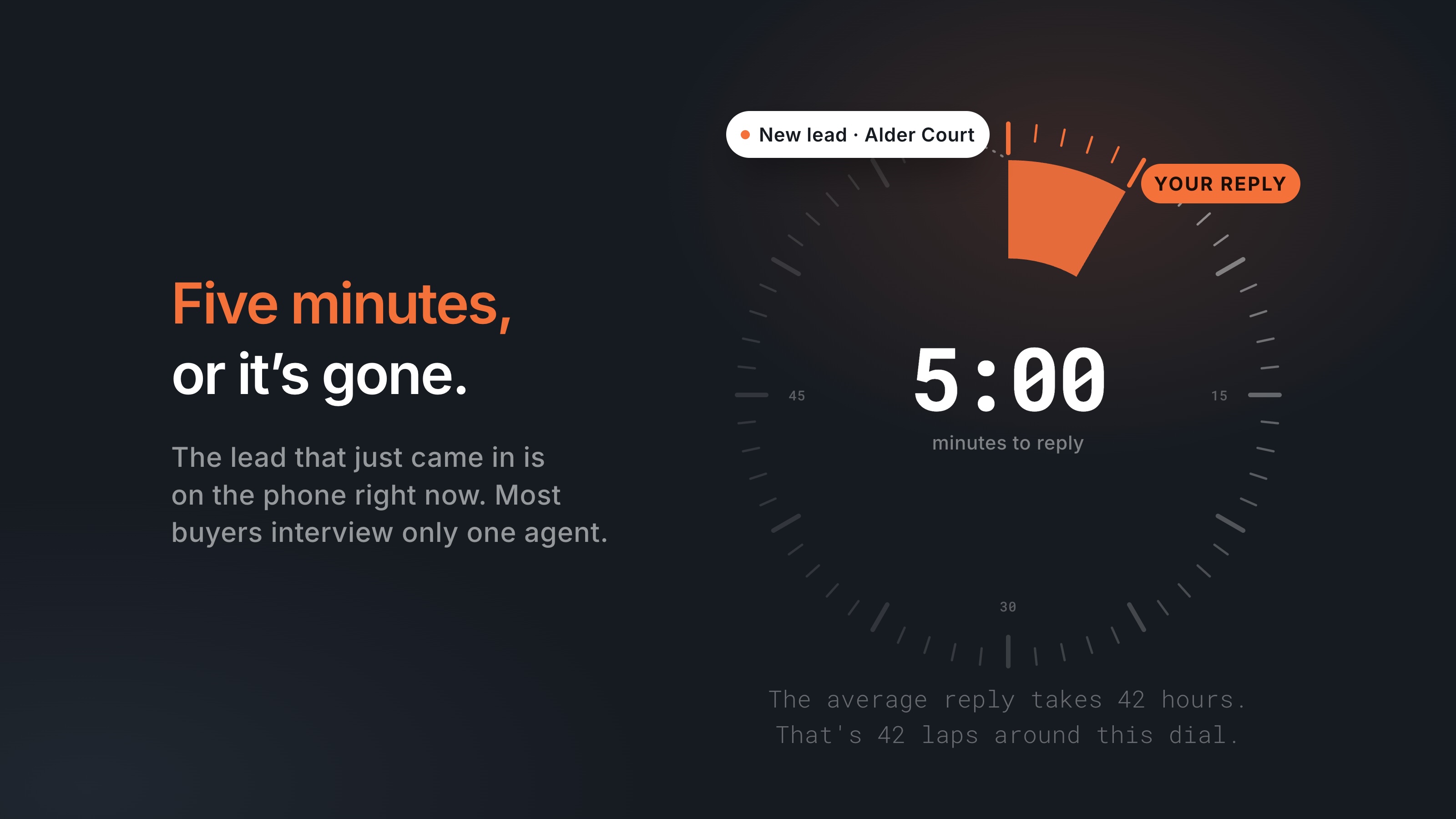
Speed to lead is the time between an inquiry and a real response from you. It is one of the most important parts of lead conversion that an agent can directly control. Research shows a steep drop in qualification rates after the first hour, while real estate buyers often interview only one agent. This guide explains what the data supports, how a solo agent can build realistic coverage, and what to say on the first call.
What does the research say about lead response time?
A widely cited study was published in Harvard Business Review by Oldroyd, McElheran, and Elkington in 2011. Analyzing 1.25 million sales leads across 29 B2C and 13 B2B companies, they found that firms attempting contact within an hour of a query were nearly seven times as likely to qualify the lead, defined as a meaningful conversation with the decision maker, as firms that tried even an hour later. They were more than sixty times as likely to qualify the lead as firms that waited 24 hours or longer.
The companion finding shows how much room companies had to improve. The same researchers audited 2,241 U.S. companies with a live web-generated test lead. Only 37% responded within an hour, the average response time among companies that responded at all was 42 hours, and 23% never responded.
The response window matters in real estate, too. In the NAR 2025 Profile of Home Buyers and Sellers, buyers typically reached out to just one agent before getting a response, and 74% interviewed exactly one agent before deciding. A quick, useful reply improves your chance of becoming that interview.
Why is speed so decisive for portal and website leads?
An online inquiry captures a moment of interest, not a decision. The person who tapped "request info" is already looking at the listing and motivated enough to ask a question. Replying while the property is still fresh lets you continue a conversation they started. Hours later, you may have to rebuild the context and their attention.
Portal economics add pressure because an inquiry may be distributed to or visible to multiple agents. When you have paid for the opportunity, a slow response reduces the value of that spend. That is why the lead generation guide compares sources by cost per closed deal: response time can affect the return on everything you spend upstream.
Speed matters most at the beginning, but a quick first reply is not a complete follow-up plan. A lead you reach in five minutes may still need a week-one cadence, such as attempts on days 1, 2, 4, and 7 across calls, texts, and email. Leads who are not ready now need an appropriate nurture path. Fast response opens the conversation; drip campaigns help you stay in touch over time.
How can a solo agent realistically respond in 5 minutes?
Start by accepting that you cannot always reply personally within five minutes. You will be in showings, closings, and appointments. Build coverage in layers so a lead receives a useful acknowledgment quickly, even when your personal response has to wait.
- Layer one: an automated acknowledgment. Send each web or portal lead an immediate text or email that is personal in tone, specific to the property when possible, and honest: "I'm with clients until 3, but I have your question about [address] and I'll call you as soon as I'm out. If it's urgent, reply here." The message does not qualify the lead, but it confirms that the inquiry reached you and sets an expectation. Automated texting is subject to consent and disclosure requirements that can change, so confirm your current workflow with your broker or legal counsel before using it.
- Layer two: visible availability. Block two or three daily windows for lead response and return every new inquiry within the nearest one. A realistic response window, paired with an honest automated acknowledgment, is more useful than a five-minute promise you cannot consistently keep.
- Layer three: coverage for live calls. Sign calls and direct inquiries often carry strong immediate intent. An AI voice assistant or answering service can respond when you cannot, capture the caller's details, and send you a summary. What voice AI can and cannot handle is covered in a separate guide. AgentsCard's AI Voice is currently on the waitlist and is designed to support this inbound gap.
- Layer four: the handoff. Whether an automated text, voice assistant, or person responds first, the lead should land in one pipeline with its source and context attached and a next action scheduled. Automation should move the inquiry toward a useful human conversation.
Avoid a setup in which new inquiries receive no acknowledgment, calls go to voicemail, and the CRM gets checked only at night. By the time you respond the next day, the prospect may already be speaking with another agent.
What should you say in the first call?
Answer their question first, then offer something useful and ask one qualifying question. This should feel like a conversation, not an application form. Adapt the property-specific details to what you actually know, then use this structure:
Open with their context: "Hi Jordan, it's Sam Rivera — you asked about the house on Alder Court a few minutes ago. Great timing, I know that street well."
Answer, then add: Answer exactly what they asked, then volunteer one useful detail the listing does not make obvious, such as property taxes, showing availability, or what similar homes have sold for.
One qualifying question at a time: "Is Alder Court the neighborhood you're focused on, or are you earlier in the looking?" Then, naturally across the call: timeline, financing status, whether they're working with anyone.
Close with a concrete next step: a showing, a list of similar homes tonight, or a buyer consultation. Aim to end the first call with an agreed action, whether that is time on the calendar or information arriving in their inbox.
Two post-settlement notes matter. First, "are you working with an agent?" is not small talk. If the prospect is under a written buyer agreement, respect it and move on. Second, many agents now need a written agreement before touring a home with a buyer. Follow your current brokerage and MLS rules; the buyer agency agreements guide includes scripts for handling that conversation clearly.
How do you measure and improve your speed to lead?
Measure the gap between lead arrival and first human contact by source each week. Do not rely on an estimate. Your CRM should show when each lead arrived, when someone first responded, and which inquiries still need attention.
This is where the right tools help. AgentsCard Smart CRM surfaces new and aging leads in a priority list, explains the signals behind the score, and suggests a next step such as a call, text, or email. A CRM should do more than store a lead; it should make the next action clear while interest is still high. If you are building that system from scratch, start with the solo agent's CRM setup.