How to Test Which Real Estate Agents AI Recommends in Your Market
A repeatable 15-minute test for seeing which agents appear in AI answers, checking the evidence, and deciding what to improve in your public presence.
By Rajwinder Mahal
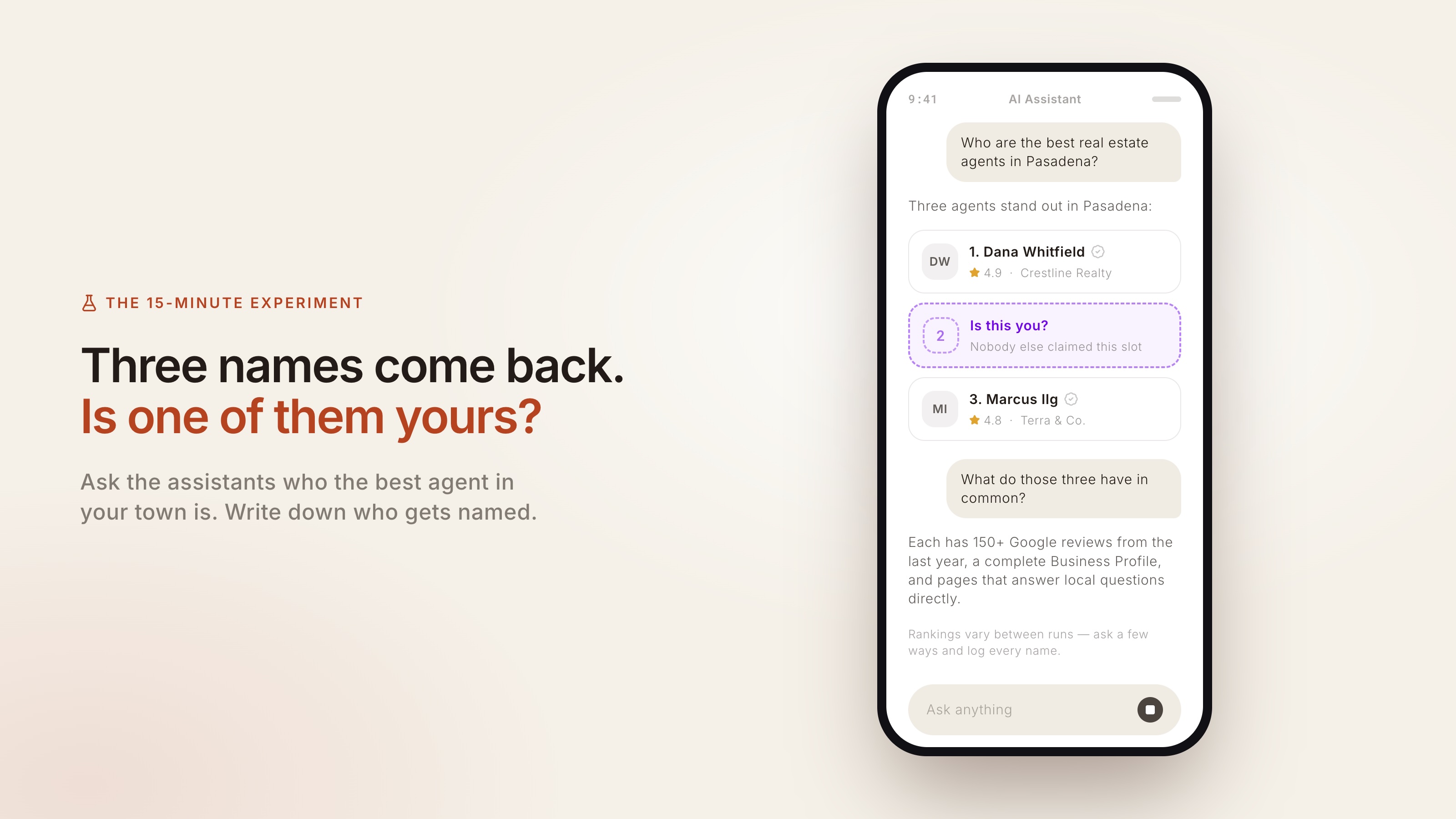
Spend 15 minutes asking ChatGPT, Gemini, and Perplexity which real estate agents they suggest in your market. The answers will not reveal a fixed ranking formula, but they can show whether your name appears, which sources the assistants cite, and whether the facts about you are accurate.
This is worth checking because BrightLocal's Local Consumer Review Survey 2026 found that 45% of consumers use generative AI tools for local business recommendations, up from 6% a year earlier. The test below gives you a repeatable baseline and a practical way to decide what to inspect next.
How do you run the experiment?
Open ChatGPT, Gemini, and Perplexity in a private browser window and log out where possible. This can reduce account-based personalization, although location and other context may still affect the answer. Ask each assistant the same questions and write down every agent it mentions.
Use prompts like these, filling in your actual market:
- "Who are the best real estate agents in [city]?"
- "I'm buying my first home in [city/neighborhood]. Which local agent should I work with?"
- "Who's a good listing agent to sell a [property type] in [city]?"
- "I'm relocating to [city] for work and need help finding a [property type] near [commute destination]. Recommend a real estate agent."
- "Tell me about [your name], real estate agent in [city]."
For each answer, log three things: who was named, what evidence or sources the assistant cited, and whether the facts were correct. Question 5 is a useful control. If the assistant can describe you accurately when asked directly, your public identity is discoverable in that test. If it draws a blank or confuses you with someone else, inspect the sources that should establish your name, brokerage, and market.
Expect variation. Answers can change with the wording, location, available sources, and model version. Look for patterns across tools and prompts instead of treating one response as a verdict.
What should you examine about the agents who appear?
No public checklist explains why a particular assistant selected each name. Some products search the live web, some rely partly on model knowledge or partner data, and the source mix can change. Use the agents who appear as a comparison set and look for patterns in their public footprints:
- Current, detailed reviews. Reviews are a public record of client experience, and AI increasingly summarizes them. BrightLocal found that 82% of consumers read AI-generated review summaries. A profile with recent reviews that mention specific neighborhoods, property types, and services gives people and machines more context than a collection of one-line ratings.
- A complete Google Business Profile. For agents who qualify for an individual-practitioner profile, it provides structured local details, contact information, and reviews. It is especially relevant to Google's own local products and may be retrieved elsewhere on the web.
- A consistent identity. Current information about the agent's name, brokerage, phone number, and service area across the website, business profile, portals, and social accounts makes the business easier to identify accurately.
- Pages with useful facts. A bio or market page that states verified experience, specialties, service areas, and local knowledge is easier to understand than a paragraph of generic claims. Use only figures you can support publicly.
Public production data, brokerage pages, news coverage, directories, location, and the wording of the query may also influence an answer. The test cannot tell you how much weight any assistant gave those inputs. Its value is narrower and more practical: it shows whether your public presence is easy to find and whether assistants describe it accurately.
Why don't great agents show up?
Many successful agents build their businesses through a sphere, referral network, and brokerage relationships that leave a limited public trail. That model still works, but an assistant can only use the information available to it. If your results, experience, and local knowledge are not documented on accessible public pages, an AI tool may have little reliable material to cite.
Common gaps include stale or sparse reviews, no eligible Business Profile for the individual agent, an outdated brokerage page as the only web presence, and conflicting identities across directories. None of these proves why an assistant omitted a name, but each is worth fixing because it also makes it harder for prospective clients to verify the agent.
AI responses are often shorter than a traditional results page, so each mention can carry more attention. NAR's same profile found that 67% of first-time buyers and 76% of repeat buyers interviewed only one agent. Being mentioned does not guarantee an inquiry, but it can matter early in a buyer's research.
What should you do if you're invisible?
Use the results to choose a practical starting point. The full playbook is in our guide to getting found by AI, but this test can narrow the next step:
- If assistants cannot identify you accurately: check your website, eligible Google Business Profile, brokerage page, license record, and major directories. Correct your name, brokerage, phone number, and service area where needed.
- If they know you but do not mention you in broader prompts: compare your public reviews, profiles, and useful local content with the agents who appear. Strengthen the clearest gap without assuming it guarantees a recommendation.
- If they mention you with incorrect facts: follow the citations when available, search for the stale information, and correct or retire the source you control.
Re-run the experiment monthly and log the results. There is no standard timeline for a corrected source or stronger profile to affect an AI answer, and single runs are noisy. Our 30-minute AI visibility audit turns the review into a scored checklist, while AEO vs SEO explains why this work overlaps with, but is not identical to, traditional SEO.