AEO vs SEO for Real Estate Agents: What You Need to Do Differently
A practical comparison of what SEO and AEO share, what changes in AI-generated answers, and where real estate agents should focus first.
By Rajwinder Mahal
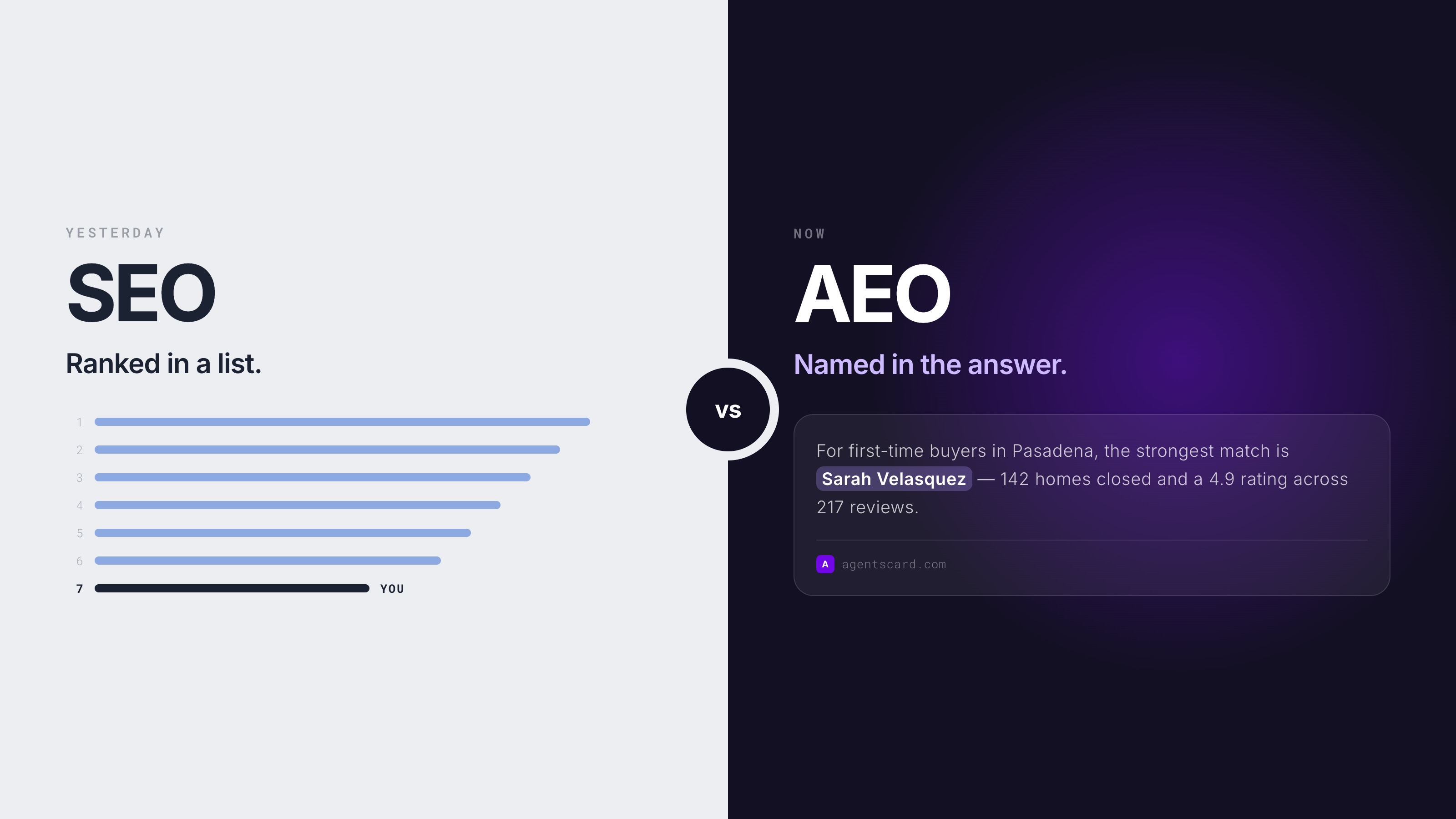
Traditional SEO helps your pages and business appear in search results. Answer engine optimization (AEO) helps make your information easier to understand and use in direct answers, including AI-generated responses. One focuses on visibility in a results page; the other adds the possibility of being summarized, cited, or mentioned inside an answer.
For a working real estate agent, this is not a second marketing job. SEO and AEO share much of the same foundation. The differences are mainly in how you structure information, how AI systems may use it, and how you measure the result.
What is AEO in plain English?
Answer engine optimization is the practice of making content and business information easy for answer systems to understand, retrieve, and use. That includes AI assistants such as ChatGPT, Gemini, and Perplexity, as well as answer features inside search products such as Google AI Overviews. Traditional SEO aims to improve visibility in ranked search results. AEO adds a focus on direct answers, citations, summaries, and accurate brand mentions.
Generative engine optimization (GEO) overlaps with AEO but is not simply another name for it. GEO usually refers more specifically to visibility in responses created by generative AI systems. AEO is the broader term and can also include featured snippets, voice answers, and other direct-answer formats. In practice, agents will use many of the same tactics for both.
The distinction matters because direct answers are becoming a larger part of online research. Google reported AI Overviews reaching 2 billion monthly users on its Q2 2025 earnings call. BrightLocal's Local Consumer Review Survey 2026 found that the share of consumers using generative AI tools for local business recommendations rose from 6% to 45% in one year, while the share using Google for local reviews fell from 83% to 71%. People are not abandoning search, but more of them now encounter generated answers alongside traditional results.
What stays the same between SEO and AEO?
The foundations overlap heavily: be a well-documented, well-reviewed, clearly described business on a site that machines can access. If you have invested in sound local SEO, much of that work can also support AI visibility. Specifically:
- Reviews remain important. They help prospective clients assess your work and can influence local search visibility. Some AI products also summarize or retrieve review content, although the sources vary.
- Your Google Business Profile remains a core local asset. For eligible agents, it can support visibility in Google's local products and provide current facts that other services may retrieve or repeat.
- Credibility still grows across sources. Consistent business information, useful content, authentic reviews, and credible mentions make your public identity easier to verify.
- Technical basics still apply. A crawlable, fast, mobile-friendly site is easier for search engines and other permitted crawlers to access, even though AI products do not all use the same index or crawler.
That overlap is why most agents do not need to choose between SEO and AEO. Build a strong search foundation, then make the information easier to extract, cite, and verify in direct answers.
What actually changes with AEO?
Four shifts are useful to understand:
- From rankings to inclusion. Traditional SEO measures positions, impressions, clicks, and local-pack visibility. AEO also asks whether your business is mentioned or your page is cited in a generated response. A rank tracker cannot capture that on its own, so use a repeatable AI recommendation test.
- From keywords alone to complete questions and answers. Search terms still matter, but content that resolves a question clearly is easier for conversational systems to interpret and use. Start with a descriptive heading and a direct answer, then add the local detail and sources a client needs.
- From clicks alone to citations, mentions, and accuracy. Traffic and inquiries still matter. A citation or accurate mention is an additional visibility outcome, even when the user does not click through. Track it alongside, not instead of, website and lead metrics.
- From broad claims to extractable facts. Dates, service areas, sourced market figures, credentials, and appropriate structured data are easier to interpret than generic brand language. Strong writing still matters, but specific facts give an answer system something concrete to use.
What does not change is the need for evidence. Hidden prompts, keyword stuffing, and batches of low-value AI pages do not make your business more useful or credible.
What should a working agent prioritize?
Start with the shared foundations, then add the AEO-specific layer. This is a practical sequence, not a published ranking formula:
- Complete your eligible Google Business Profile and keep the contact details, service areas, photos, and business description current.
- Run a compliant review-request process so prospective clients can see recent, authentic feedback.
- Maintain one owned website that states the facts: who you are, where you work, your specialties, how you work, and how to contact you. Add appropriate schema markup to reinforce the visible information.
- Keep your identity consistent across directories and profiles, especially after a brokerage, phone number, or service-area change.
- Publish clear local answers through market FAQs and neighborhood pages grounded in verified information and your first-hand expertise.
- Run a monthly AI spot check using the same prompts in ChatGPT, Gemini, and Perplexity. Log mentions, citations, and factual errors. Our 30-minute audit makes this systematic.
Items 1–4 are familiar local SEO work. Items 5–6 add answer-focused content and a new way to monitor visibility. If you have only a few hours each month, start with whichever of the first four contains an obvious gap. The reasoning behind each layer is in our guide to getting found by AI.
Should you hire an AEO agency?
You may not need a specialist until you have measured your starting point and identified work you cannot complete yourself. Be cautious with "guaranteed ChatGPT placement" pitches. No vendor can promise organic inclusion across changing AI systems, and paid or sponsored placements are separate from organic answers.
Ask a vendor what, specifically, they will change, which sources they will work on, how they will measure progress, and what you will own when the engagement ends. Useful deliverables should be concrete: profile corrections, technical site work, structured data, editorially reviewed local content, or a repeatable review workflow.
Paid help can make sense for execution: a developer to add and validate schema, a platform to manage review requests and profile information, or a writer who can turn your local knowledge into useful neighborhood pages. Warning signs include guaranteed placement, secret methods that cannot be explained, deliverables you cannot verify, and plans to mass-produce lightly reviewed pages in your name.
Compare the fee with the time and expertise the work actually requires. A solo agent may be able to handle profile updates and content planning, while technical implementation or ongoing operations may justify outside help. The right choice depends on the gap, not the label "AEO."