
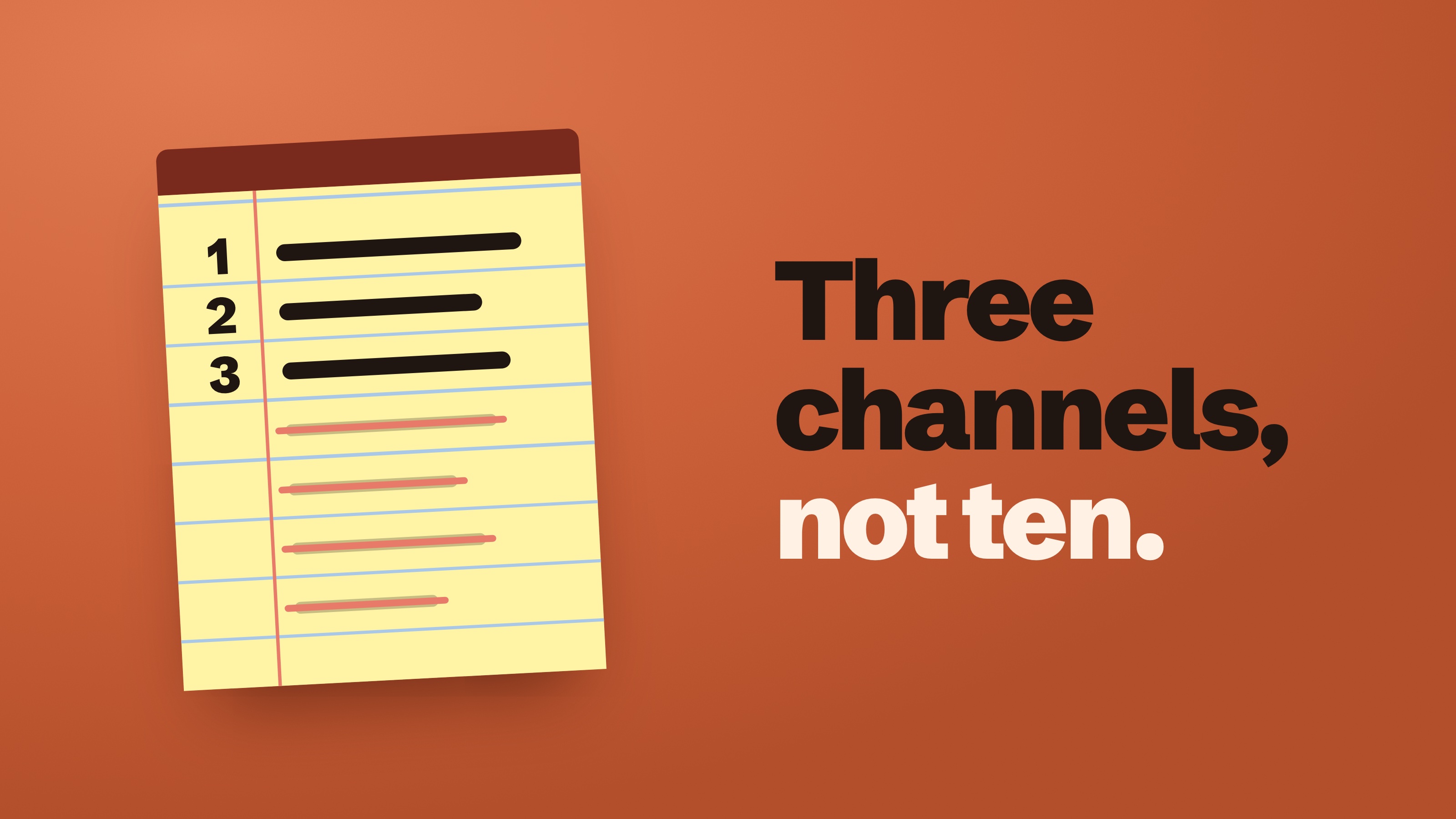
A real estate marketing plan is not a list of everything you could do. It's a short list of what you will actually do, on a calendar, when you're also showing houses, negotiating repairs, and returning forty calls. This playbook gives you the working version: how to pick three channels instead of ten, a 90-day calendar built around weekly blocks, honest budget tiers, and a clean split between what to automate and what has to stay you. Everything here assumes you're a working agent with four to five focused hours a week for marketing.
Why do most real estate marketing plans fail?
A plan becomes hard to maintain when it asks you to do too much. The typical January plan (post daily, launch a YouTube channel, farm two neighborhoods, start a podcast) collapses by February because it was designed for the agent's ambition instead of the agent's calendar. Marketing compounds only through consistency, and consistency is only possible at a scope you can sustain during your busiest month, not your slowest one.
The math of the business says depth beats breadth anyway. In NAR's 2025 Profile of Home Buyers and Sellers, 43% of buyers found their agent through a friend, neighbor, or relative and another 15% used an agent they'd worked with before, and the typical REALTOR® earned 28% of their business from past clients and customers, per NAR's 2026 Member Profile. Most marketing that wins listings isn't introducing you to strangers; it's keeping you visible, credible, and easy to find for people one step from your existing sphere. A plan that does three things well for twelve weeks straight serves that reality. A plan that does ten things sporadically serves nobody.
So before any tactics: your plan needs a scope you can keep during a triple-closing week, a calendar that says when each thing happens, and a measurement habit at the end. That's the whole architecture. The rest of this guide fills it in.
Which marketing channels actually work for real estate agents?
Think of the channel menu in three layers: a base layer you don't get to skip (reviews, your web presence, and your sphere), a choice layer where you pick two or three (short-form video, email, local content, events, paid), and an amplification layer you add only after the first two run on rails. Here's the menu with honest numbers where they exist:
- Reviews and your Google presence. Not optional. BrightLocal's 2026 Local Consumer Review Survey found 97% of consumers read reviews for local businesses and 68% won't consider one rated below 4.0, and 45% also reported using AI tools for local recommendations, although each tool draws on different sources. The Google reviews guide covers this layer end to end.
- An owned, AI-readable web presence. Where referrals land when they search your name, and the raw material AI search engines quote. Foundation, not channel.
- Sphere and past-client touches. Start with a 12-touch follow-up plan and a working referral system. If your plan has budget for ads but no calls to past clients, reorder it.
- Short-form video. In NAR's 2025 Technology Survey, social media was members' most-cited source of quality leads at 39%, the strongest number any channel posts. The catch: in NAR's consumer research, only about 1% of buyers say they found their agent through social media. The surveys measure different things and do not isolate short-form video. Use social content to stay visible to your sphere and help prospective clients get to know your work. The Reels playbook is the execution guide.
- Email. Email gives you a direct way to reach subscribers. Litmus reports email ROI of $36 for every $1 spent, a broad marketing figure rather than a forecast for an individual agent. The hyperlocal newsletter is the format built for agents.
- Local content. Neighborhood guide pages capture relocating buyers early and give both Google and AI assistants something specific to cite. Slow to build, durable once built.
- Paid leads and ads. Legitimate, but bottom of this list on purpose: 12% of members named digital advertising a top quality-lead source in NAR's survey, and paid only pays when your follow-up system is already excellent. The lead generation guide covers cost math and when buying makes sense.
Pick from the choice layer by two criteria: where your actual clients pay attention, and what you'll still be doing in week twelve. An agent who hates being on camera should not build a plan around Reels; an agent who loves hosting should weight client events heavily. The best channel is the one you'll sustain.
One compliance note that covers every channel: fair housing rules apply to marketing, not just showings. Describe properties and places, never the people who "belong" there, and never target or exclude audiences by protected class in any paid tool.
What does a 90-day real estate marketing plan look like?
Thirty days of foundation, thirty days of rhythm, thirty days of compounding, with every recurring task assigned to a weekly block. The blocks are the actual plan; the tactics just fill them. A working default: Monday, 60 minutes (write: newsletter section, guide progress, or scripts), Wednesday, 60–90 minutes (batch-record and schedule the week's video), Friday, 45 minutes (five sphere calls or notes, review requests, respond to everything), plus 15 minutes daily for replies and DMs.
Days 1–30: foundation. Fix what every other channel depends on:
- Write your positioning sentence (next section) and your canonical bio.
- Clean up your Google Business Profile and your website or microsite so your name, markets, and contact info match everywhere.
- Kickstart reviews: send five requests to past clients using the scripts that don't feel like begging.
- Segment your database (past clients, sphere, active leads) so every later send has an audience. Your CRM does the remembering; the solo agent setup is a weekend project.
- Start the video habit small: two Reels per week from the idea bank, batched on Wednesdays.
Days 31–60: rhythm. Launch the recurring engines and let the calendar carry them: newsletter issue #1 goes out, with future issues scheduled for the same week each month, video moves to its sustainable cadence, Friday sphere calls become non-negotiable, and you draft your first neighborhood guide in Monday blocks. When a deal closes this month, run the full closing sequence (photo, permission, just-sold post, review request) so the win compounds instead of evaporating.
Days 61–90: compounding. Publish the guide, send the next monthly newsletter, keep the cadence, and add one seasonal play: a small client event, a market explainer tuned to what clients are nervous about this quarter, or a farming push in your target neighborhood. Then, on day 90, run the measurement review (last section) and decide what earns a place in the next 90.
That's the whole plan. It fits on one page, survives a busy month, and every piece feeds another: reviews feed AI visibility, video warms the sphere, the newsletter carries the guide, the guide captures searchers, and every closing restarts the loop.
How do you position yourself as the hyperlocal expert?
Positioning is one sentence: the place you demonstrably work, the person or problem you're best at, and the proof that makes both credible. "I help first-time buyers win in Maple Grove and the northwest suburbs, with 31 closings there in the last two years" is a position. "Your trusted partner for all your real estate needs" is a shrug. Every asset in this playbook gets easier and more effective once the sentence exists, because you stop inventing a message per post and start repeating one message per market.
Your experience in a few neighborhoods gives you specific information to share. Local, dated content about recent sales, new developments, or septic rules can answer questions a national guide leaves open. It may also give search engines and AI assistants useful material to surface when people ask about the area. Narrow public positioning doesn't narrow your business; you'll still take the referral two towns over. It narrows what you're known for, which is what makes you referable at all.
How does one asset become five?
Make the week's content once, then translate it. Never create five times. The Monday writing block produces one core asset (a newsletter section, a guide segment, a market answer), and everything else that week is a format shift of it:
- Newsletter section. The canonical, written version with the numbers.
- Reel. The same insight said to camera in 30 seconds, hook first.
- Social post or carousel. The three-line text version with one chart or photo.
- Guide update. The durable version, added to the relevant neighborhood page where search and AI can find it.
- Conversation script. The version you say on Friday calls and at showings all week.
The order matters less than the discipline: one idea per week, adapted for five uses. Agents who burn out are almost always running five ideas per week instead. This is also where AI assistance genuinely helps (reformatting is exactly what it's good at), with the prompt library covering the translation jobs, and the judgment (which idea, which numbers, what's true) staying yours.
Which real estate marketing ideas deserve a slot in the plan?
Ideas are cheap; slots are scarce. When a weekly block opens up, pull from a short bench of proven plays instead of inventing from scratch. These twelve cover most of what working agents actually get results from, grouped by the block they fill:
- Sphere plays (Friday block): a handwritten note after every real conversation; home-anniversary messages on closing dates; a quarterly "what your home is worth now" personal note to owners in your farm; one deliberate "who do you know" ask per quarter, not per call.
- Video plays (Wednesday block): a three-part series per listing (tour, neighborhood, the story of the deal); "what $400K buys in [town]" comparisons; myth-versus-fact on whatever clients are nervous about this quarter; a monthly 60-second market minute using the same numbers as your newsletter.
- Local-authority plays (Monday block): one neighborhood guide per quarter; a local business or development spotlight; a plain-English explainer when the market makes headlines; an annual "year in review" for your farm with real sales data.
- Conversion plays (built once, then maintained): a link-in-bio page that actually captures instead of scattering taps; QR codes on signs and open-house materials pointing at one profile; a standing open-house follow-up sequence so Saturday's sign-ins become Monday's conversations.
The test for any new idea is the same as for any channel: name the block it lives in and the number it should move. If it has neither, it's a distraction wearing a marketing costume.
How much should a real estate agent spend on marketing?
Spend time before money. Most agents' highest-return marketing (sphere calls, review requests, consistent posting) costs nothing but the weekly blocks. For the cash portion, NAR's 2025 Technology Survey gives an honest baseline: 24% of members spend under $50 a month on lead generation, 27% spend $50–250, 15% spend $251–500, and 19% spend more than $500. Half the industry runs on modest budgets; what separates outcomes is consistency and follow-up, not spend.
Three example budgets to adapt to your costs:
- ~$50/month, the systems tier. Your platform stack: web presence, CRM, review requests, email. At this tier every dollar goes to infrastructure that makes free channels work. (AgentsCard covers the web presence and CRM in this tier, with plans from $25/month.)
- $100–300/month, the presence tier. Adds print where it earns it (closing-gift photo prints, a farming postcard for one neighborhood, open-house materials) and a modest event budget spread across the year.
- $500+/month, the amplification tier. Paid leads or ads, added only once you track follow-up and conversion. Paid traffic into a leaky follow-up system is the most expensive mistake in agent marketing. Judge it on cost per closed deal, never cost per lead; the lead-gen guide has the math.
Whatever the tier, give every dollar a job and a review date. "We've always run this ad" is not a job.
What should you automate, and what should stay human?
Automate production and memory; keep judgment and relationships human. That one line sorts almost every case:
Automate (or systematize): first drafts of listing copy, captions, flyers, and email; scheduling and posting cadence; review requests after closing; drip sequences for long-timeline leads; the reminders for every dated touch in your follow-up plan. None of this is where your value lives, and all of it is where plans die of friction.
Never automate: the Friday calls, anything responding to a life event, negotiation-adjacent conversations, and final approval of anything that publishes under your name. An AI draft with your corrections is your voice at scale; an AI draft posted unread is a liability with your headshot on it. And keep your numbers honest. Every market stat you publish should trace to a source you can name, because your credibility is the product.
This is the division of labor AgentsCard's Marketing Studio is built around. Once a listing is in your dashboard, it generates the flyer, social posts, and captions on-brand, with your logo and colors, for you to review, edit, and publish wherever you already market. It gives you a starting point for your own review. You approve and post everything yourself, which, for anything carrying your name, is the right default anyway. Email content is coming soon, and publishing straight from AgentsCard is on our roadmap.
How do you measure whether the plan worked?
Set aside fifteen minutes each month to review whether your marketing is creating useful conversations and business. Track:
- Conversations started. Calls, texts, DMs, and replies from real humans in your market. These show whether your content is prompting people to get in touch.
- Database growth. New contacts with a name, a channel, and a next step. A viewer you can't follow up with is a rounding error; capture paths are what turn attention into an asset.
- Review count and recency. Because 74% of consumers in BrightLocal's survey only weigh reviews from the last three months, velocity beats lifetime totals.
- Appointments and signed agreements. A useful measure of whether conversations are progressing.
- Closings by original source. Logged in your CRM at closing, so that after two or three quarters you know what your marketing actually earns, per channel, in dollars.
At each 90-day boundary, rank your channels by conversations and closings per hour invested. Keep the top two, fix or replace the bottom one, and add nothing new until something proves itself for a full quarter. Agents don't fail at marketing for lack of ideas. They fail for lack of a calendar, and you now have one.