
Building a real estate team is a sequencing problem: hire the right roles in the right order, at the moment your own production genuinely demands them, on top of systems that already work. Production data gives some context. In NAR's 2026 Member Profile, agents working individually reported a median of 9 transaction sides and $2.7 million in sales volume, while team-based residential specialists reported a median of 32 sides and $17.5 million. Those figures do not establish that forming a team causes higher production, and they leave out payroll and management costs. This guide covers the whole sequence: when you're actually ready, who to hire first, how to structure compensation, how to route leads without fights, the shared tech stack, and the brand question every team eventually hits.
When are you actually ready to build a real estate team?
You're ready when you're consistently turning away or under-serving business you already generate, not when you're tired, and not when a conference speaker makes teams sound inevitable. Teams are common but far from universal: 21% of REALTORS® worked as part of a team in 2025, with an average team size of four. The other 79% include plenty of highly profitable solo agents who decided leverage wasn't their business model. A team amplifies whatever you have; if what you have is an inconsistent pipeline, it amplifies that.
Concrete readiness signals, in rough order of importance:
- Your lead flow exceeds your follow-up capacity for months at a stretch. Leads sit for days, past clients stop hearing from you, and your follow-up system, not your lead generation, is the bottleneck.
- You can name the specific work you'd hand off. "I need help" is a feeling; "I spend 15 hours a week on compliance paperwork, scheduling, and MLS entry" is a job description.
- You have 6–12 months of the new role's cost in reserve. A hire should pay for themselves, but not in week one, and payroll that depends on next month's closing is how teams implode.
- Your systems survive without your memory. If the follow-up cadence, the listing checklist, and the client handoffs live only in your head, hire number one becomes a full-time guessing game. Document first, hire second.
A useful gut check: a team should exist to protect the activities only you can do (listing appointments, negotiations, relationships) by moving everything else to people and systems built for it. If you can't articulate which activities those are, you're not ready yet.
Who should you hire first on a real estate team?
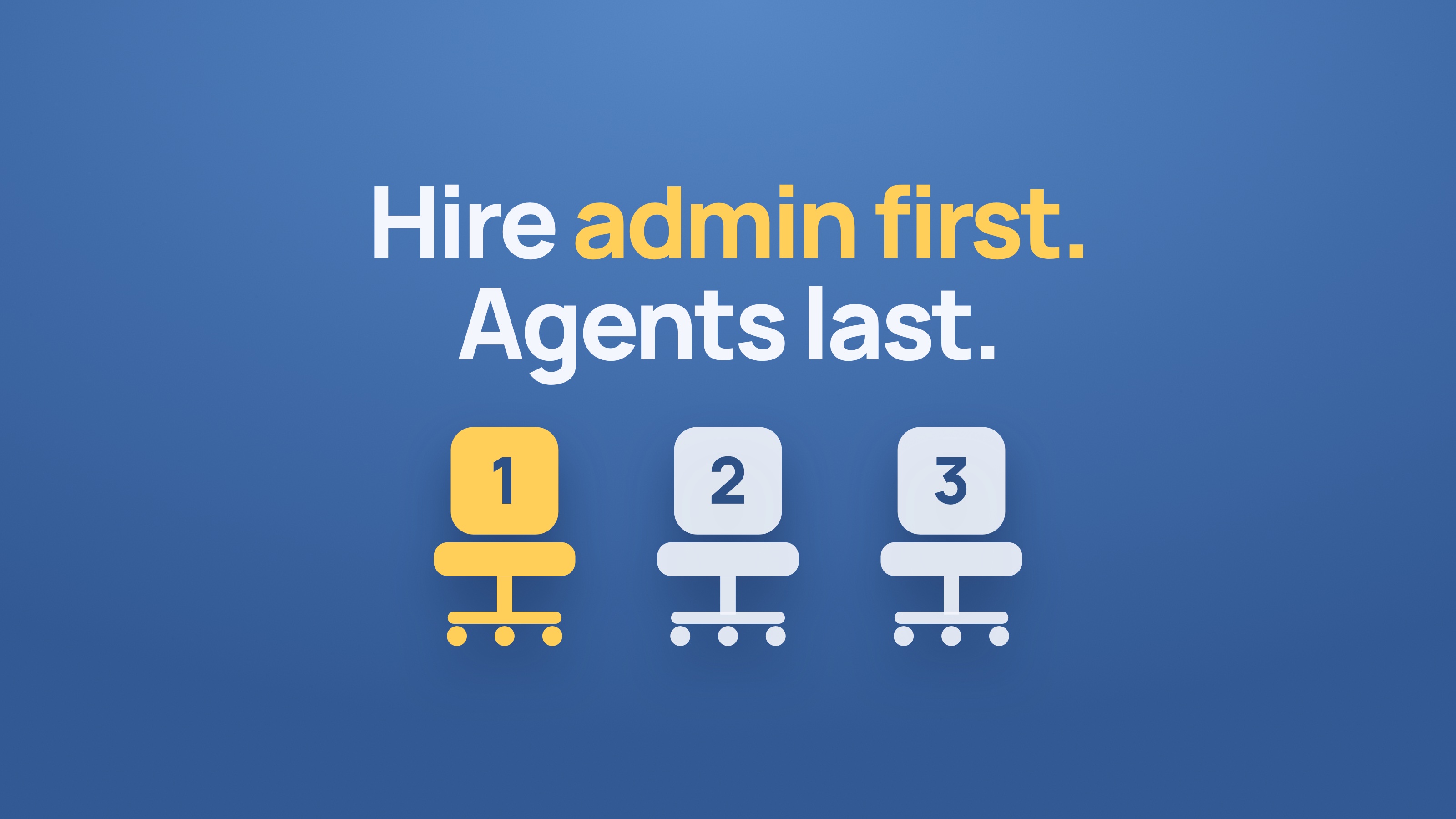
Start with the work that most limits your capacity, often administration. The classic sequence (administrative support, then a showing assistant or transaction coordinator, then buyer's agents) survives because each hire frees the next constraint, and skipping ahead usually backfires.
Hire one: administrative support. Full-time or part-time administrative help can be a practical first step. Paperwork, compliance, scheduling, MLS entry, and database hygiene are time-consuming tasks, subject to your state's rules on what unlicensed staff may do. Hiring a buyer's agent first is the classic mistake: it adds a second unsupported producer to a business that couldn't support one, and admin work now gets done twice as badly.
Hire two: a transaction coordinator or showing assistant. Which one depends on where your hours actually go. Pull the last 90 days of your calendar and count. If contract-to-close eats you alive, a TC (employed or per-file) buys back the most hours per dollar. If you're driving buyers around all weekend, a licensed showing assistant keeps your weekends for listing appointments.
Hire three and beyond: buyer's agents. Now a buyer's agent joins a business with real support and consistent overflow leads, the two things that make that seat succeed. This is also where written expectations become non-negotiable: lead follow-up standards, response-time SLAs, database usage, and conversion accountability, agreed before the first lead is routed.
Two structural notes. First, every team structure needs your broker's sign-off. Team names, advertising, and supervision rules are regulated at the state level and vary meaningfully, so involve your broker before you print anything. Second, "fractional" counts: a shared VA, a per-transaction TC, or a part-time assistant is a legitimate first hire and a much smaller bet.
How should you structure real estate team compensation?
Match the pay structure to the role's responsibilities, put it in writing, and accept that there is no industry-standard number. Splits vary by market, lead source, and what the team actually provides. Broad patterns that hold up:
- Admin and operations roles are salaried or hourly, often with a per-closing or quarterly bonus tied to team results, because you want them invested in volume without commission whiplash on work that isn't sales.
- Transaction coordinators are salaried in-house or paid per file if contracted.
- Buyer's agents typically work on a split of their side of the commission. The team's share is justified by what the team provides: leads, admin, marketing, coaching, brand. Team-generated leads command a larger team share than agent-generated business, and many teams use graduated splits that improve with production so top performers aren't punished for growing.
- Team leads earn the margin between what the team produces and what it costs, which is why underpriced admin and free-riding seats hurt the leader first.
Three rules keep comp from becoming the thing that breaks the team. Price the seat on its full value, not just the split. A 50% split with strong leads, admin, and coaching may produce better net income than a 70% split without support, and your recruiting pitch should say so explicitly. Put every split, cap, referral carve-out, and exit rule in a written agreement your broker has reviewed, including what happens to pipeline and database when someone leaves. The brokerage-switch mess has a team-sized equivalent, and it's ugly without paperwork. And revisit comp annually: the split that was generous for a new agent is resented by the same agent doing three times the volume two years later.
(Compensation agreements are contracts. Have your broker and, where it matters, an attorney review them. Nothing here is legal advice.)
Does the math of a team actually work?
Run the arithmetic on the specific seat before you post the job, because a team is a margin business and the margin is thinner than the volume numbers suggest. The exercise takes twenty minutes and kills more bad hires than any interview. (The numbers below are illustrative math, not benchmarks. Plug in your own.)
For a support hire, the question is: what does an hour of your selling time produce? Take your last twelve months of gross commission income and divide by the hours you actually spent on income-producing activities (appointments, negotiations, live conversations), not total hours worked. Most agents doing this for the first time discover two things: the per-hour value of their selling time is far higher than they assumed, and shockingly little of their week is spent earning it. Estimate the hours an assistant would free, then compare their full cost with the additional business you can realistically handle. Freed time creates capacity; it does not guarantee revenue.
For a producing hire, the question is: what does the seat net after everything? A buyer's agent closing a deal generates their side's commission; from the team's share, subtract the cost of the leads you fed them, the admin and TC time their files consume, the marketing that carries them, and the management hours they take from your calendar. Seats look profitable on split percentage and lose money on fully loaded cost all the time, usually because the leads were expensive or the seat closed too few of them. This is why conversion accountability isn't culture theater; it's the line between a seat that compounds and a seat you subsidize.
For the team as a whole, track leader profit, not team volume. Team GCI is a vanity number if payroll, splits, lead spend, and software eat it. The honest scoreboard is what the leader nets against what they netted solo, plus the value that's genuinely new: time off that doesn't stop the business, an asset with transferable systems, and a pipeline that doesn't depend on one person's hustle. Some leaders net less per deal and consider the trade excellent; the failure is not knowing you made it.
How do you route leads and keep everyone accountable?
Pick one distribution rule, write it down, and instrument it. Fairness among agents comes from consistency plus visible data, not from any particular algorithm. The three standard models are round-robin (equal turns, simple, ignores skill), shark tank or first-claim (fast, rewards hunger, favors whoever's glued to their phone), and performance-weighted (more leads to agents who convert, with a floor so newer agents can climb). Most teams land on a hybrid: round-robin within tiers, weighted by conversion, adjusted for capacity. We cover the trade-offs, SLAs, and clawback rules in the lead distribution guide.
Whatever the model, the accountability loop is the same:
- A speed standard. Response-time expectations in minutes, not "promptly." The case for minutes is the best-documented finding in lead conversion research.
- A clawback rule. Untouched leads return to the pool automatically after a defined window, so an unanswered inquiry can reach an available agent.
- Shared visibility. Every lead, touch, and stage change in one shared CRM, so "who touched what, when" is a report, not an argument.
- A weekly numbers rhythm. Leads received, contacted, appointments set, agreements signed, per agent, reviewed together. Conversion, not lead count, is what you manage.
Accountability without shared data becomes micromanagement; shared data without a standard becomes a dashboard nobody opens. You need both, and they're only possible when the whole team works one system.
What tech stack does a real estate team need?
One shared system for the pipeline, and as few satellites around it as you can get away with. The solo-agent tool sprawl problem (five subscriptions doing four jobs) gets worse on teams, because now every extra tool is multiplied by headcount and by the coordination cost of agents working from different sources of truth. (The brokerage tech stack audit applies to teams at smaller scale.)
The non-negotiables:
- A shared CRM with routing. Team-wide contact database, shared pipelines, lead assignment, and per-agent activity visibility. This is the accountability layer from the previous section; without it, none of that works. If you're evaluating options, the 12 questions before you buy apply doubly to teams, especially data ownership and per-seat pricing.
- A consistent web presence for every agent. Each team member needs a professional, up-to-date profile that captures leads into the shared system, because clients research the individual agent, and increasingly so do AI assistants. One stale agent bio is a leak in a shared pipeline.
- Shared follow-up automation. Drip sequences and reminders that run team-wide, so follow-up quality doesn't depend on which agent caught the lead.
- A review engine. Reviews accrue to both the agent and the team brand; a systematic request process after every closing compounds for everyone at once.
This is the problem AgentsCard is built to consolidate, with AI-ready agent microsites for every team member, shared lead capture and routing, team pipelines, marketing, and reviews in one platform for teams. Any good team stack can be assembled from parts. What you're buying with consolidation is adoption, one login, and one source of truth instead of five. AgentsCard Team is coming soon, and the rest of the platform is available to every agent today.
Should agents build the team brand or their personal brands?
Both, deliberately: the team brand carries trust, consistency, and the shared pipeline; each agent's personal presence carries the relationships that referrals and repeat business actually flow through. Teams that force a choice usually regret it. All-team branding makes recruiting harder (producers won't erase themselves), and all-personal branding means the team lead is renting production with no compounding asset.
The workable split: the team owns the brand system (name, look, listing marketing, the marketing plan), while every agent maintains a complete, consistent individual profile inside it: their own bio, their own reviews, their own contact identity, presented on the team's platform. That consistency matters more than it used to, because AI assistants recommending agents read individual identities (name, market, reviews, track record), and an agent who exists only as a headshot on a team page is harder to identify from that page alone.
The ownership questions (who keeps the database, the reviews, and the social accounts when someone leaves) belong in the written agreement from day one. Clear ownership terms can prevent disputes when someone leaves.
What are the most common team-building mistakes?
Watch for these five problems as the team grows:
- Hiring producers before support. As discussed above: a buyer's agent joins, gets no leads and no systems, produces little, and leaves inside a year, confirming the leader's suspicion that "teams don't work." The seat was set up to fail.
- Recruiting on split instead of value. If the pitch is a percentage, the agent you win is the agent who leaves for a better percentage. Teams that retain people recruit on the full seat (leads, support, coaching, brand) and can show the math from the previous section out loud. (The same logic drives brokerage-level recruiting.)
- Skipping the written agreement. Splits, caps, lead ownership, database ownership, review ownership, exit terms. A handshake can leave important expectations unresolved when someone leaves.
- Adding tools instead of adopting one. A new subscription per problem until the team runs on five half-used systems and nobody trusts any number. Fewer tools, fully adopted, beats more tools every time. Adoption is the metric that predicts whether a stack pays for itself.
- Growing headcount past the leader's management capacity. As headcount grows, more of the leader's job becomes management, meaning coaching, pipeline reviews, and accountability conversations. Leaders who don't want that job should stop growing before it arrives (a perfectly good outcome) or hire an operations lead who does want it. Pretending the job hasn't changed is how strong small teams become mediocre medium ones.
The common thread: teams break at the seams between people, and the seams are exactly where documentation, agreements, and shared systems live. Boring infrastructure is what makes the exciting part, leverage, actually compound.
What does a team that runs without constant oversight look like?
The end state is a team that produces without the leader touching every transaction: leads arrive and get routed by rule, follow-up runs on cadence, every closing generates a review request and joins the past-client system, the weekly numbers meeting runs off live dashboards, and the leader's calendar is listing appointments, coaching, recruiting, and keeping the producers they already have. Most teams get there in stages. First the leader stops doing admin, then stops touching every buyer, then stops being the only rainmaker.
The failure mode at every stage is the same: adding people faster than systems. If a step in your operation only works because you personally remember it, it isn't a system yet, and the next hire will prove it. Build one documented process at a time and track how well it works, and add each seat when the previous one is genuinely full.
Frequently asked questions
Team structures, compensation, and advertising rules are governed by your state licensing law and your broker. Treat this guide as business strategy, not legal advice.